
Cost to Finish Basement: What It Really Costs and What to Expect
So, you're thinking about finishing your basement. It's a fantastic way to add a ton of living space to your home without the headache and cost of building an addition. But the big question is always the same: what's it going to cost?
Let's get right to it. On average, you can expect the cost to finish a basement to land somewhere between £32 and £80 per square foot. For a standard 1,000-square-foot basement, that means you're looking at a total cost anywhere from £7,000 to over £23,000. It’s a wide range, I know, but it all comes down to what you're planning to do with the space.
The Bottom Line on Basement Finishing Costs
The final price tag on your project can swing wildly depending on your vision. Are you picturing a simple, open-plan family room? Or are you dreaming of a full-blown apartment down there with a slick wet bar and a full bathroom? The more complex your plans, the more you'll invest.
This chart gives you a quick visual on how the overall cost tends to scale up with the size of your basement.
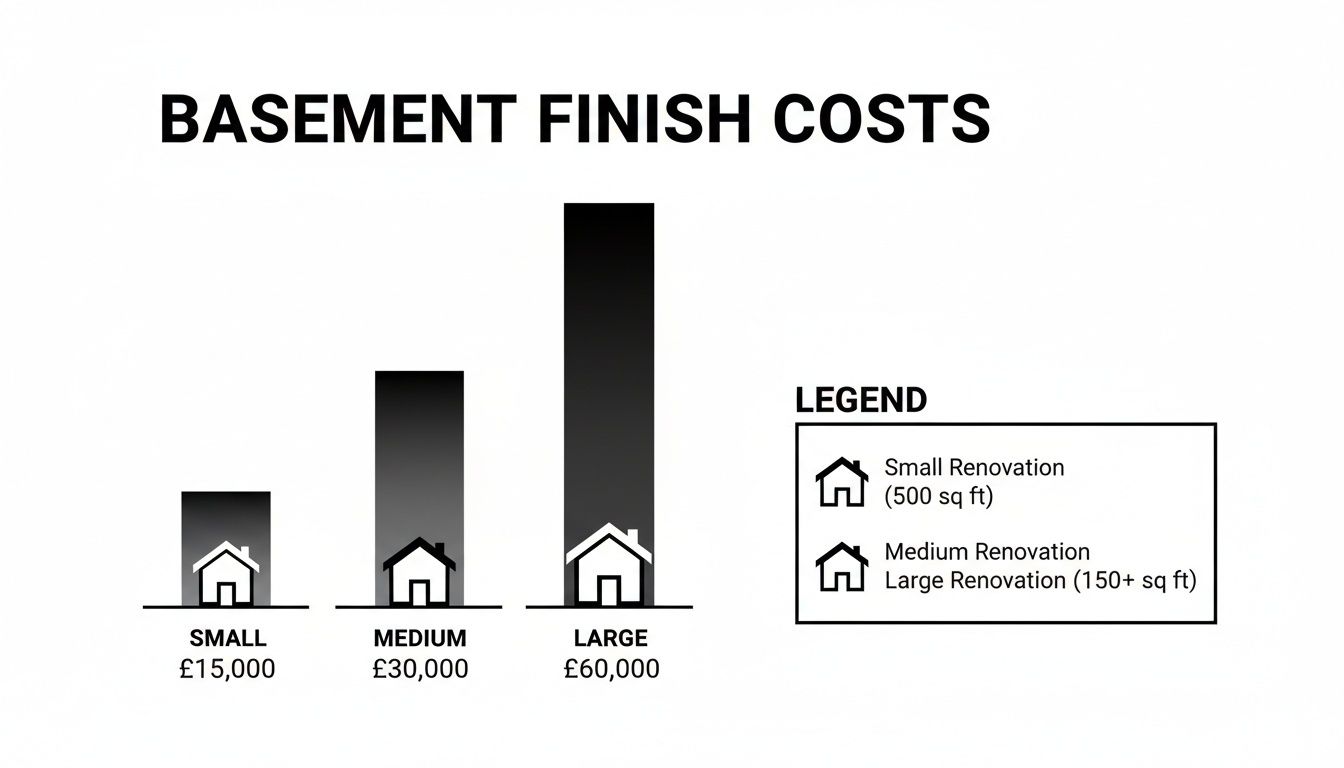
As you can see, size is one of the biggest drivers of the final cost. A bigger footprint simply requires more materials and more labor.
A Snapshot of Potential Costs
To really get a handle on your budget, you need to think about two things: the square footage and the quality of the finishes you choose. Basic finishes usually mean simple drywall, standard electrical outlets, builder-grade carpet, and a painted ceiling. On the other end of the spectrum, high-end finishes could include things like custom built-ins, stone accent walls, luxury vinyl plank floors, a wet bar, and some really cool lighting.
The latest numbers show the average for standard basement finishes is running between £32 and £80 per square foot. While plenty of homeowners get a basic 1,000-square-foot project done for between £7,000 and £23,000, the national average has crept up to around £24,050. It's also worth noting that labor typically eats up about 40% of that total. You can dig into more basement remodeling cost statistics to see how things look in different parts of the country.
Key Takeaway: The level of finish you select is just as important as the size of your space. A small, high-end basement can easily cost more than a large, basic one.
To help you get a clearer picture, I've put together a table that breaks down the potential costs. This should give you a solid starting point for figuring out what's realistic for your home and your wallet.
Estimated Basement Finishing Costs by Size and Finish Level
This table breaks down the estimated total costs for finishing a basement, showing how the price changes based on both square footage and the quality of the materials you pick.
Basement Size (Sq. Ft.) | Basic Finishes (Cost Range) | Mid-Range Finishes (Cost Range) | High-End Finishes (Cost Range) |
|---|---|---|---|
500 | £16,000 - £22,500 | £22,500 - £35,000 | £35,000 - £50,000+ |
1,000 | £32,000 - £45,000 | £45,000 - £70,000 | £70,000 - £100,000+ |
1,500 | £48,000 - £67,500 | £67,500 - £105,000 | £105,000 - £150,000+ |
As you can see, the numbers can climb quickly once you move into mid-range and high-end territory. This is where planning becomes so important.
Before you start getting quotes, playing around with an AI Home Design app can be a game-changer. It helps you see what different finishes actually look like in your space, which makes it way easier to decide where to spend your money to get the most bang for your buck.
What Really Drives the Cost of Finishing a Basement?
Ever wonder why one basement project costs double what a similar-sized one does? It's rarely just about the square footage. A handful of key factors can dramatically swing your budget one way or the other, and knowing what they are is the first step to building a realistic plan.
Think of it like buying a car. The base model gets you from A to B, but once you start adding the sunroof, leather seats, and premium sound system, the price tag climbs fast. Your basement is no different.
The Starting Condition of Your Space
Your budget starts with the basement you have right now. If you're lucky enough to have a dry, level space with no major issues, you’ve got a perfect blank canvas. But let's be honest, many basements—especially in older homes—come with some baggage.
These "before you can even start" fixes aren't optional, and they can add thousands to your costs right out of the gate.
Waterproofing: Any hint of dampness, leaks, or musty smells needs to be your first priority. Interior waterproofing can run from $3,000 to $7,000, but serious issues requiring exterior work could push past $15,000.
Foundation Repairs: Are those cracks in the wall just cosmetic, or are they a sign of something more serious? Minor crack repairs are often just a few hundred dollars, but major structural work can easily top $10,000.
Leveling the Floor: You can't put down nice flooring on an uneven concrete slab. Getting it perfectly flat with a self-leveling compound usually adds $2 to $7 per square foot to the project.
Labor Rates and Permit Fees
Where you live matters. A lot. Labor can eat up 40-50% of your entire project budget, and the rates contractors charge vary wildly from place to place. A crew in a major city simply has higher costs than one in a small town, and that gets passed on to you.
On top of that, you have permits. Pretty much any basement finish will require permits for electrical, plumbing, and the general construction itself. These fees, which can range from $500 to $2,000, aren't just red tape—they ensure the work is safe, up to code, and won't cause problems when you eventually sell your home.
Getting building regulations approval from your local council is non-negotiable. It ensures that all work, especially the critical electrical and structural stuff, is inspected and signed off. This protects both your family and your investment.
Complex Additions and Custom Features
This is where your vision really starts to shape the price tag. A basic finish—framing, drywall, simple lights, and carpet—is your baseline cost. Every bell and whistle you add from there layers on more expense.
Here’s a look at some of the most common (and costly) upgrades:
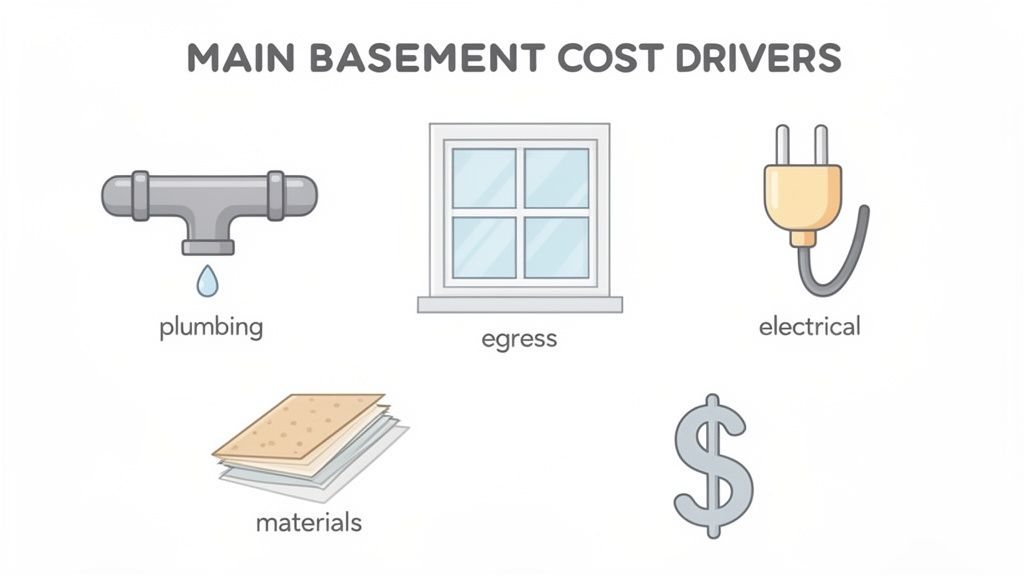
Adding a Bathroom: This is a big one. A simple powder room might add $5,000 to $10,000, but a full bathroom with a shower will likely run you $15,000 to $25,000. The real budget-buster is the plumbing, especially if your contractor has to jackhammer the concrete floor to run new drain lines.
Installing an Egress Window: If you want a legal bedroom in the basement (and you probably do), building codes require an egress window for safety. This isn't a simple window install; it means cutting a large opening in your foundation. Expect to pay between $2,500 and $6,000 for each one.
Custom Electrical and HVAC: That home theater you're dreaming of needs special wiring. The home gym needs a dedicated circuit for the treadmill. You’ll also need to extend your home's ductwork to properly heat and cool the new space, which can add another $1,000 to $2,000.
Wet Bars and Kitchenettes: Just like a bathroom, adding a sink and appliances means new plumbing and electrical lines. For a deep dive into the possibilities and costs, check out our ultimate basement kitchen design guide.
Before you get too attached to high-ticket features, it can be incredibly helpful to see them in your space first. Using an AI Interior Design tool lets you visualize different layouts and finishes, helping you decide which additions give you the most bang for your buck.
A Detailed Breakdown of Project Expenses
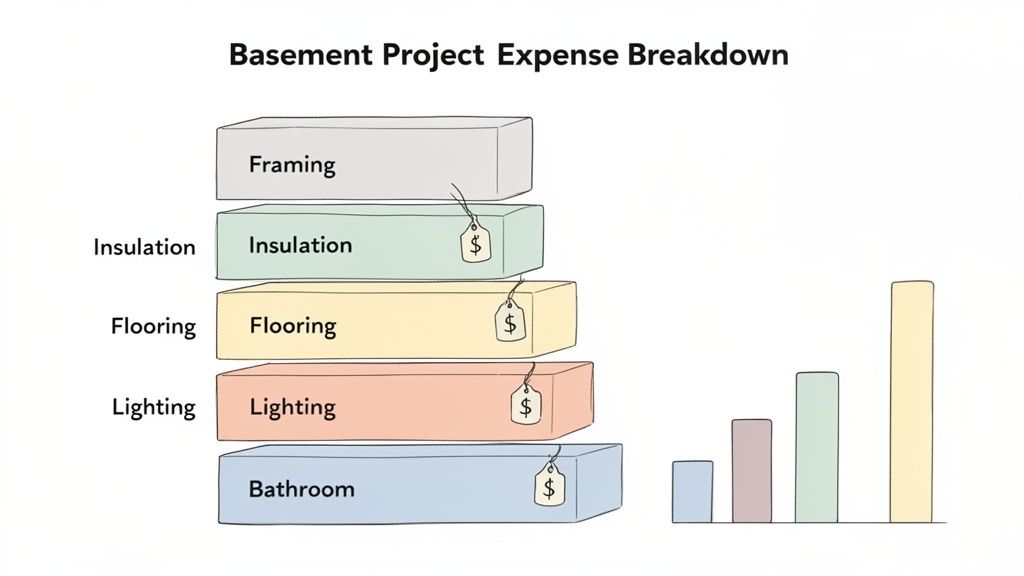
To get a real handle on the cost to finish a basement, you have to look at where every dollar is actually going. The best way to do this is to stop thinking about one huge, overwhelming number and start seeing it as a series of smaller projects. Each one—framing, drywall, flooring—has its own price tag.
This mindset shift is the key to creating a realistic budget and understanding a contractor's quote. It lets you see what’s driving the cost, helping you decide where to spend your money for the biggest impact and where you might be able to pull back.
Core Construction Costs
The bones of your basement are where a good chunk of the budget goes, right after you've dealt with any moisture or structural problems. These are the non-negotiable steps that transform that concrete box into a genuine living space.
Framing and Insulation: First, you build the skeleton for your new rooms. Framing walls typically runs between $7 and $16 per linear foot. Right alongside that is insulation, which is absolutely critical for making the space comfortable and energy-efficient. Plan on another $2 to $4 per square foot for that.
Drywall Installation: With the frame in place, it’s time to hang drywall to create your actual walls and ceiling. Having a pro handle the installation—including taping, mudding, and sanding for a smooth finish—usually costs $2 to $4 per square foot. For a typical 1,000-square-foot basement, you’re looking at $4,000 to $8,000 just for this phase.
Remember, labor is a huge part of these numbers. While you can save money doing it yourself, a mistake in framing or a bad drywall finish can be a real headache—and an expensive one—to fix down the line.
Systems and Utilities
Next up are the brains of the operation: the electrical, plumbing, and HVAC that make your basement safe and functional. This is not the place to cut corners. You'll almost certainly need licensed professionals to ensure everything is done to code.
Plumbing, especially, can become a major line item if you’re adding a bathroom or a wet bar. Digging into concrete floors for new drain lines adds up fast. For a deeper dive into what that involves, take a look at our complete guide on the topic: https://www.decor8.ai/post/your-complete-guide-to-a-basement-bathroom-remodel
Electrical Work: This covers everything from running new wires and adding outlets to installing light switches and maybe even a new subpanel. A standard setup will likely cost between $1,500 and $4,000, but this can climb if you’re planning custom lighting for a home theater or bar.
HVAC Extension: To keep the temperature just right, you'll need to tie into your home's heating and cooling system. This usually means adding new ductwork and vents, which can cost anywhere from $1,000 to $2,000.
Finishes and Final Touches
Here’s the fun part! This is where your personal style comes to life, but it’s also where the budget can get away from you if you aren't careful. From flooring to paint colors, every choice you make has a direct impact on the final cost.
To help stay on track, visualizing these finishes beforehand is a game-changer. Using an AI-powered tool like Decor8 lets you play with different flooring, paint, and lighting options virtually. An AI Room Design tool allows you to see what works before you buy anything, preventing those expensive "change-of-mind" moments mid-project.
To give you a clearer picture, let's break down the costs of some common features you might be considering for your basement.
Itemized Cost Estimates for Common Basement Features
This table outlines the typical cost ranges for individual features, which can help you build a more detailed and accurate budget from the ground up.
Project Feature | Average Cost Range | Key Considerations |
|---|---|---|
Flooring Installation | $3 - $12 per sq. ft. | Price varies widely by material. Carpet is budget-friendly, while LVP or tile costs more but offers better durability and water resistance. |
Professional Painting | $2 - $4 per sq. ft. | Includes walls, ceiling, and trim. This is a popular DIY task to save on labor, but a pro ensures a flawless finish. |
Recessed Lighting | $150 - $300 per light | Cost includes the fixture and professional installation. More complex layouts or dimmers will increase the price. |
Interior Doors & Trim | $500 - $2,000+ | Covers standard pre-hung doors, baseboards, and casing. Custom doors or high-end trim work will be on the higher end of this range. |
By thinking about your project in terms of these individual components, you can mix and match to fit your budget while still achieving the look you want.
Here are some more detailed costs for those finishing touches:
Flooring: Your options here are vast. Carpet is often the most affordable at $3 to $7 per square foot installed. Luxury Vinyl Plank (LVP) is a fan favorite for its durability and water resistance, running $5 to $12 per square foot. It's smart to research the best waterproof flooring for basements to protect your investment.
Painting: A professional crew will typically charge $2 to $4 per square foot of wall space. While many homeowners tackle this themselves to save some cash, the crisp lines and even finish from a pro can be worth every penny.
Lighting: Basic recessed can lights usually cost $150 to $300 per light to have installed. If you're dreaming of stylish pendant lights over a bar or cool sconces in a media room, be sure to budget more for those fixtures.
Doors and Trim: Don't forget the finishing carpentry! Interior doors, baseboards, and window trim really complete the space. Budget around $500 to $2,000 for materials and installation, depending on the quality and style you choose.
Hiring a Pro vs. Going DIY
This is one of the biggest decisions you'll make when finishing your basement: do you hire a contractor or roll up your sleeves and do it yourself? This choice goes way beyond just the cost of labor. It’s a decision that will shape your timeline, your final budget, and the overall quality of your new living space.
The main reason anyone considers the DIY route is the chance to save a lot of money. Since labor can eat up around 40% of the total project cost, doing the work yourself can make a massive dent in the final price tag. If you've got the skills, the right tools, and—most critically—the time, a DIY basement finish can be a hugely rewarding project.
The True Cost of a DIY Basement Remodel
Let's be real: going DIY isn't just a simple trade of your time for money. There are a bunch of "hidden" costs that can sneak up on you if you're not ready for them. Before you dive in, you need to be brutally honest with yourself about whether you can handle tasks like framing, running electrical wires, and finishing drywall.
Beyond your personal skillset, here are the other costs you need to budget for:
Tool and Equipment Costs: You probably don't own every specialized tool for the job. You might need to buy or rent things like a miter saw, a drywall lift, or even a concrete saw. These costs can easily climb into the hundreds, if not thousands, of dollars.
The Price of Mistakes: A wall that isn't quite straight or a plumbing connection with a slow leak isn’t just annoying—it's expensive. The cost of buying new materials to redo a job, or eventually calling in a pro to fix your mistake, can wipe out your initial savings in a hurry.
Time Is Money: A professional crew might knock out your basement in 6-8 weeks. For a DIYer working nights and weekends, that same project could stretch out for 6-8 months. That extended timeline can be a serious drain on you and your family.
One study of a DIY basement project found it still took eight full weeks of dedicated evenings and weekends, even with the homeowner doing almost all the labor. That really puts the enormous time commitment into perspective.
The Value of a Professional Contractor
Hiring a general contractor definitely looks like the more expensive option on paper, but their value is about so much more than just swinging a hammer. A great contractor is really a project manager, making sure every single step of the renovation goes off without a hitch. That efficiency can end up saving you a ton of money and stress in the long run.
Here’s what you’re actually paying for when you hire a pro:
Expertise and Efficiency: These guys do this for a living. They know how to spot problems before they happen, they're experts on local building codes, and they can get the job done in a fraction of the time it would take an amateur. Their experience is your best defense against costly mistakes.
Industry Connections: Contractors have a network of trusted subcontractors, like electricians and plumbers, and relationships with suppliers. This often gets you better prices on materials and access to reliable tradespeople who might otherwise have a six-month waiting list.
Project Management: A contractor runs the whole show. They’re the ones pulling permits, scheduling inspections, coordinating material deliveries, and managing the entire work schedule. This frees you from the logistical headache of running a massive construction project yourself.
Peace of Mind: There’s real value in knowing your project is insured, built to code, and being handled by people who know what they’re doing. The final product is almost always a higher-quality, more polished space that adds more value to your home. For more inspiration on getting that high-end look, check out our guide on DIY interior design on a budget.
So, which path is right for you? It really depends on your situation. If you're on a very tight budget, have a ton of construction experience, and a flexible timeline, DIY can be a fantastic option. For most homeowners, though, the expertise and efficiency of a professional contractor deliver a smoother, faster, and higher-quality result.
How to Maximize Your Return on Investment
It’s easy to think of finishing your basement as just another big expense. But it’s smarter to see it as an investment—one that can seriously pay off when it’s time to sell. When you do it right, the money you spend turning that concrete box into a living space can deliver one of the best returns of any home renovation project.
Thinking about the cost to finish basement in terms of Return on Investment (ROI) completely changes your perspective. You're not just spending money; you're actively converting it into home equity. The trick is to make smart choices that not only improve your daily life but will also catch a future buyer's eye.
A Smart Financial Move
Out of all the big-ticket home improvements, a basement remodel is one of the smartest places to put your money. Homeowners can realistically expect to get back about 70% of their investment when they sell their house.
That’s a fantastic ROI, especially when you compare it to other popular projects. A typical bathroom remodel might net you around 64.8%, and a major kitchen overhaul often brings back only about 65.3%.
What makes a basement so valuable? You're adding usable, livable square footage without the massive expense of building a whole new addition. You're simply making the most of the space you already have.
Features That Boost Resale Value Most
When it comes to ROI, not all basement features are created equal. If you want to get the most bang for your buck, you need to focus on additions that create legal, functional living space.
Here are the features that really move the needle on your home's value:
A Legal Bedroom: This is hands-down the biggest value-add. To count as a legal bedroom, it needs to have a closet and, most importantly, a proper egress window for safety.
A Full or Three-Quarter Bathroom: A basement with its own bathroom is a game-changer for buyers. Even a compact three-quarter bath with a shower makes the entire space infinitely more practical and appealing.
Flexible Living Space: Think open-concept. A large, multi-purpose family room or rec area lets potential buyers imagine their own lives in the space—whether it’s a kids' playroom, a home office, or a cozy media room.
Focusing on these core elements ensures your investment directly translates into a higher appraisal and selling price. Fancy, niche additions like a wine cellar might be great for you but may not offer the same universal appeal to future buyers.
Of course, it’s hard to commit to a layout without seeing it first. This is where a tool like AI Home Design comes in handy. It lets you experiment with different floor plans and finishes, helping you nail down a design that’s perfect for your family now and for buyers later.
For a deeper dive into how a finished basement impacts property values in a specific market, you can find expert breakdowns for projects like basement remodeling in Mississauga. And once the work is done, remember that showing off the new space is just as important. For pro tips on making it look irresistible, check out our guide on how to stage a home to sell faster and for more money.
Bringing Your Vision to Life with AI Design Tools
Nothing protects you from surprise costs and a disappointing outcome quite like having a clear vision from day one. Before you even think about framing a wall, being able to see the finished space helps you lock in your plan. This simple step prevents those costly, last-minute changes that can completely blow up your cost to finish basement.
Thankfully, you don't have to rely on imagination or hard-to-read blueprints anymore. Modern design tools let you see exactly how your choices will look, from the flooring under your feet to the paint on the walls. It’s like test-driving your design before you spend a dime on construction.
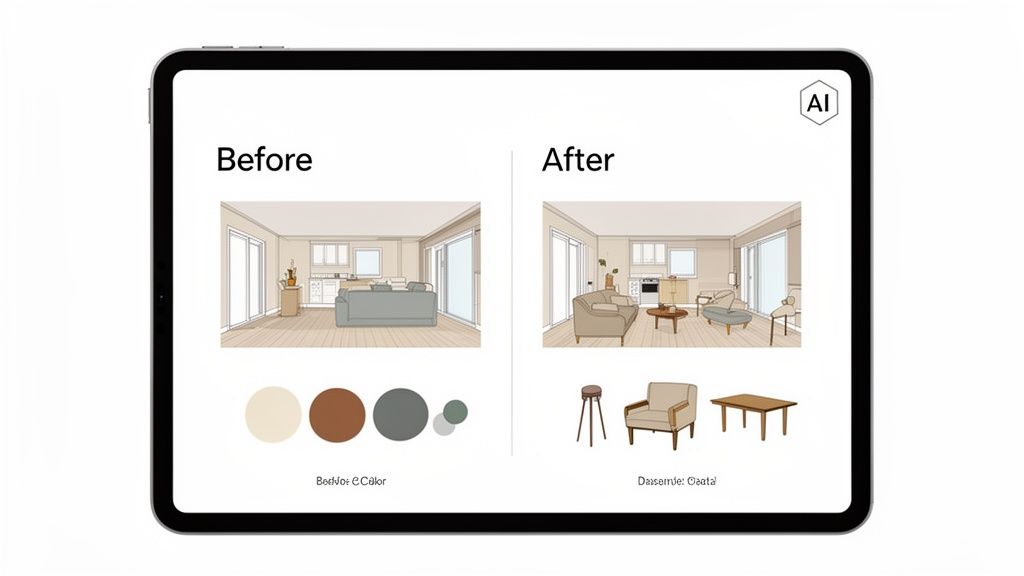
Starting with a solid visual plan is a huge part of managing your budget. When you know precisely what you want, you can communicate clearly with contractors, which means you'll get much more accurate quotes right from the start.
Visualize Your Finished Basement with AI
One of the most exciting tools available today is AI Home Design. These platforms are a game-changer. You just upload a photo of your unfinished basement, and they can generate incredibly realistic concepts in any style you can think of.
With a few clicks, you can explore a ton of different possibilities:
Generate Diverse Styles: Want to see your space as a cozy family den? Or maybe a sleek home gym? You can instantly see it transformed.
Experiment with Finishes: Curious how luxury vinyl plank looks compared to plush carpet? Or an industrial open ceiling versus traditional drywall? See the difference in seconds.
Test Paint Colors: Virtually "paint" the walls with real colors from major brands. This helps you avoid the classic, and costly, mistake of picking the wrong shade.
This freedom to experiment means you can be confident that the final result will be a space you genuinely love.
Perfecting Layouts and Staging
It's not just about looks, either. AI Virtual Staging helps you nail down the practical side of the design. You can play around with different furniture arrangements to make sure the layout flows well and feels right—all before you buy a single couch or chair. It’s the perfect way to confirm your dream furniture actually fits the space.
By solidifying your design plan digitally, you eliminate guesswork. This means fewer mid-project changes, which are a primary cause of budget overruns and timeline delays.
These tools put the power in your hands, helping you make smart decisions that line up with your budget. To see how it all works, check out this practical guide to AI interior design software. When you use AI to refine your plan, you ensure every dollar you spend helps create a space you'll enjoy for years.
A Few Common Questions, Answered
When you're thinking about a basement remodel, a lot of questions naturally come to mind. Getting a handle on the timeline, potential pitfalls, and major costs is the best way to move forward with confidence. Here are some straight answers to the questions we hear most often.
How Long Does It Take to Finish a Basement?
For a standard 1,000-square-foot basement, a professional crew can typically get the job done in about 4 to 8 weeks. That timeline usually covers everything from framing and wiring right through to the final touches like paint and flooring.
Of course, that's just an estimate. The schedule can easily stretch out if you hit a snag. Waiting on building permits, adding complex features like a full bathroom, or discovering a surprise moisture problem that needs fixing first can all tack on extra weeks to your project.
What Are the Most Common Hidden Costs?
Even the most carefully planned budget can get hit with unexpected expenses. In a basement, the biggest surprises are almost always lurking behind the walls or under the floor.
Keep an eye out for these common budget-busters:
Moisture and Foundation Issues: You might uncover leaks or cracks that need professional waterproofing before you can even think about putting up drywall.
Electrical Panel Upgrades: An older panel often can't handle the load of a whole new living area, forcing an expensive but necessary upgrade.
Egress Window Installation: If you're adding a legal bedroom, an egress window is non-negotiable. Cutting through a concrete foundation is a major job that costs a few thousand dollars.
Unexpected Structural Repairs: Tearing down old finishes can sometimes reveal compromised joists or support beams that have to be fixed for safety.
A smart move is to build a safety net right into your budget. We always recommend setting aside a contingency fund of 15-20% of your total project cost. That way, a surprise expense doesn't have to derail your entire plan.
Does Adding a Bathroom Significantly Increase the Cost?
In a word, yes. Adding a bathroom is one of the biggest single expenses you can have when finishing a basement, but it also adds incredible value.
The main reason for the high cost is the plumbing. Most of the time, your contractor will need to break up the concrete floor to run new drain and water lines. A simple half-bath can easily add $5,000 to $10,000 to the project. For a full bathroom with a shower, you're more likely looking at $15,000 to $25,000, and sometimes more, depending on how fancy you get with the fixtures and tile.
Can AI Home Décor Tools Help Me Save Money?
They absolutely can. Using an AI Home Décor tool is one of the smartest ways to plan your space and avoid costly do-overs. Think of it as a way to test drive your design ideas before you spend any real money.
You can upload a quick photo of your current basement and instantly see how different flooring, paint colors, and furniture layouts would look. This does more than just help you find a look you love—it lets you walk into a meeting with a contractor and show them exactly what you want. That clarity leads to more accurate quotes and a smoother project, which is key to staying on budget.
Ready to stop guessing and start visualizing? With Decor8 AI, you can turn a photo of your unfinished basement into a stunning, realistic design in seconds. Experiment with different styles, layouts, and finishes to create the perfect plan before you spend a dime on construction. Try Decor8 AI for free and bring your vision to life.
Comments