
Virtual Staging AI A Guide to Transforming Properties
Ever feel like you need an interior decorator on speed dial, ready to work 24/7? That's pretty much what you get with virtual staging AI. It’s a smart technology that takes photos of empty rooms and digitally furnishes them, turning a blank slate into a warm, inviting home in just a few minutes. It's the modern way to showcase a property's potential without lifting a single box.
So, How Does AI Furnish an Empty Room Instantly?
At its heart, virtual staging AI is a clever mix of computer vision and generative AI. You can think of it as a super-fast digital artist that sees a room, understands its layout, and then completely redecorates it. The whole thing kicks off the moment you upload a picture of a vacant space.
First, the AI uses its computer vision to analyze the photo. It doesn't just see pixels; it understands the room’s architecture. The AI maps out the walls, floors, and ceiling, calculating the dimensions and figuring out the perspective. It even pinpoints where the light is coming from, noting how sunlight streams through a window and where shadows should naturally fall.
From Seeing to Creating
Once the AI has a solid grasp of the space, the fun part starts. This is where generative AI steps in, acting like an automated interior designer. You pick a style—maybe Modern, Farmhouse, or Scandinavian—and the algorithm dives into a huge digital catalog to select and place furniture that fits the vibe.
This concept map breaks down the simple, three-step workflow.
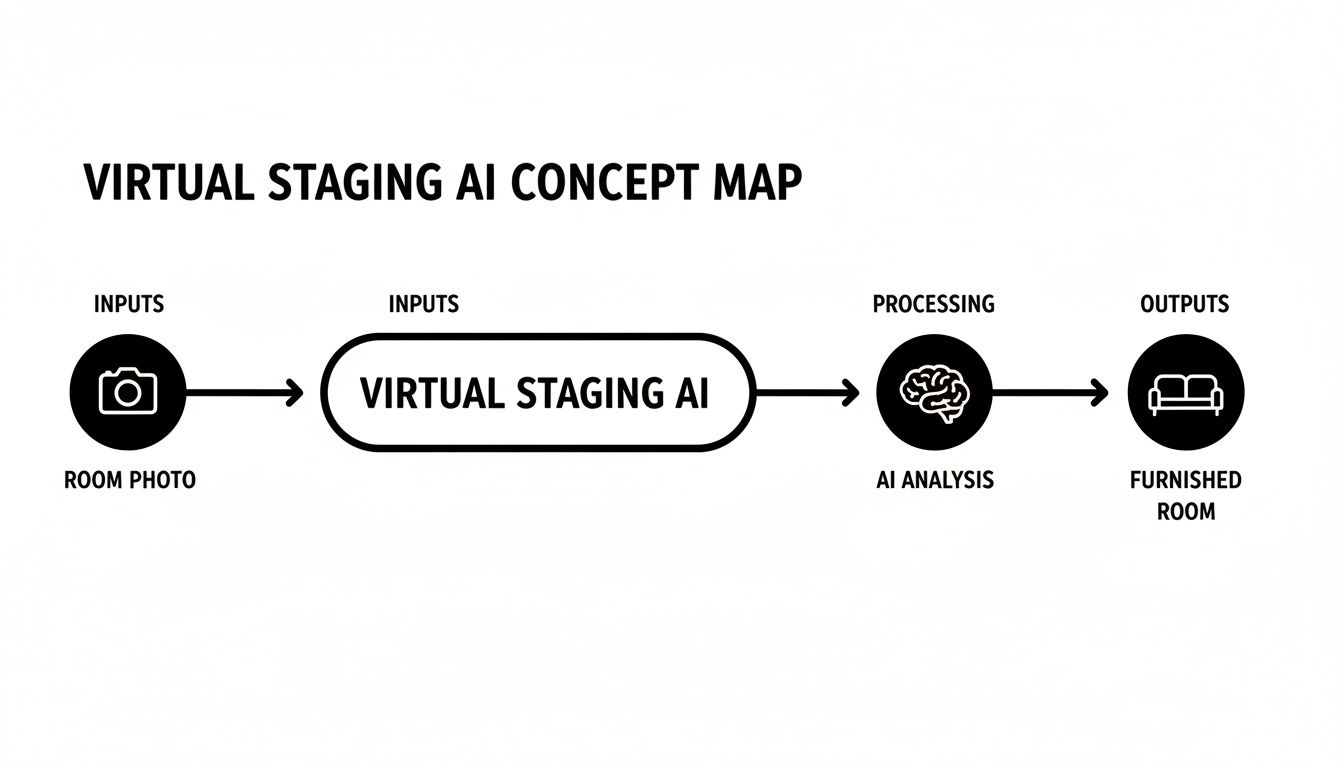
As you can see, the tech flows smoothly from a simple photo to a fully designed room, all driven by that initial intelligent analysis.
But this isn't just about dropping random furniture into a picture. The AI uses everything it learned in that first step to make the final image look completely real.
Scale and Proportion: It makes sure the virtual sofa isn’t comically oversized for the living room and that the dining table fits the space just right.
Lighting and Shadows: It adds realistic shadows under chairs and tables that perfectly match the room's own lighting, which helps "ground" the objects and make them look like they're actually there.
Perspective: Every piece of furniture is aligned with the room's natural angles, so nothing looks tacked on or fake.
A process that used to take a skilled graphic designer hours of painstaking work can now be done in seconds. The final result is a stunning, fully furnished photo that helps buyers make an emotional connection with the property. This powerful AI Room Design is changing how we market real estate.
The real magic of virtual staging AI is that it closes the "visualization gap." Studies have shown that most buyers have a hard time imagining how to use an empty room. Staged photos remove that guesswork and make it incredibly easy for them to see a property as their future home.
The Power of Instant Redecorating
The best part about this technology is its incredible flexibility. Not a fan of the first design? Just click a button and generate a new one. This lets agents and sellers create multiple looks for the same room to appeal to a wider range of buyers. That spare bedroom could be a cozy home office in one version, a nursery in another, and a home gym in a third.
To see just how dramatic these makeovers can be, take a look at these virtual staging examples. The ability to have this kind of instant creative control makes virtual staging AI an essential tool in today's market.
The Real Benefits of AI-Powered Staging
Switching from physical to virtual staging isn't just about following a trend—it's a smart, strategic move that comes with some serious advantages. Top agents are embracing AI Virtual Staging for a simple reason: it beats the old way of doing things in almost every way that matters. It all boils down to three huge wins: massive cost savings, incredible speed, and total creative freedom.
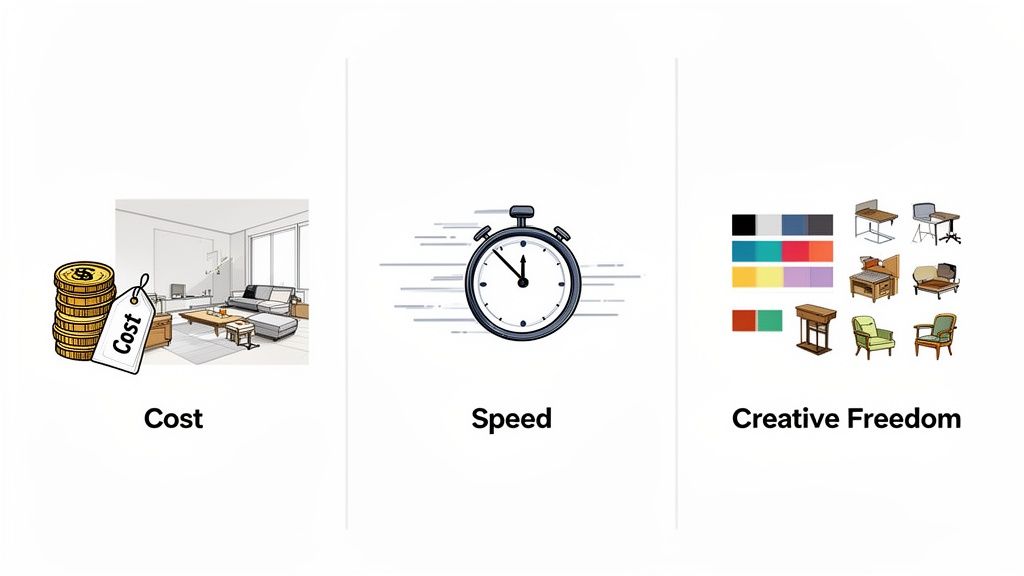
These benefits don't just exist in a vacuum; they work together to make your marketing more effective, helping you sell properties faster and for more money. Let’s dig into exactly how AI staging makes this happen.
A Radical Reduction in Cost
The most obvious win is how much money you save. Physical staging is a major budget item. You’re paying for furniture rentals, movers, insurance, and the stager's valuable time. Those costs add up fast, often hitting thousands of dollars for just one property.
AI virtual staging plays a completely different ballgame. Forget about logistics and physical goods; you’re paying a small fee for each image you stage. This isn't just hype—it's a game-changer. A typical home can cost anywhere from $2,000 to $5,000 for a 3-month physical staging contract. With AI, you can get the same job done for just a few dollars per photo.
Listings with great virtual staging get more clicks online, which leads to more showings, more offers, and faster sales. It’s a simple truth: buyers connect better with a warm, furnished space they can imagine themselves in.
From Weeks to Minutes: The Speed Advantage
In real estate, time is always money. Getting a property on the market quickly is crucial. The old way of staging can take weeks, from the first consultation and picking out furniture to finally getting everything delivered and set up. Every day of delay is a day you're not capturing buyer interest.
AI flips that timeline on its head. Using AI Home Design tools, you can snap photos of an empty house and have them beautifully staged for your listing in minutes.
What once took a team of professionals over a week to pull off can now be done on your coffee break.
This incredible speed means you can list a property almost as soon as it's ready, catching buyers when their interest is highest. And if the first design doesn't get the traction you want? No problem. You can generate a whole new look instantly without spending more money or waiting another week.
Unlocking Limitless Creative Freedom
With physical staging, your options are limited to whatever furniture is available to rent. You pick one look, and that's it. Changing your mind is an expensive and time-consuming headache.
Virtual staging AI blows those limitations wide open.
You can try out dozens of different styles in the exact same room, instantly. Wondering if a clean, minimalist vibe will perform better than a cozy modern farmhouse look? Just click a button and see for yourself. This flexibility is a powerful marketing weapon. You can learn more about the possibilities in our guide on virtual staging for empty rooms.
Target Different Buyers: Show a spare room as a professional home office, a sweet nursery for a young family, or a serene yoga studio—all from the same base photo.
Experiment with Trends: Want to try out the latest AI Interior Design trends? Apply bold colors or popular furniture styles without any risk.
Add Seasonal Touches: Make a listing feel current by adding a cozy fireplace for a winter sale or bright, airy furniture for the summer market.
This level of control lets you craft the perfect story for every property, designed to hook the right buyer.
Virtual Staging AI vs Traditional Physical Staging
When you put them side-by-side, the advantages of AI become crystal clear. The traditional method, while once the only option, now seems slow, expensive, and restrictive compared to the speed and flexibility of modern technology.
Factor | Virtual Staging AI | Traditional Physical Staging |
|---|---|---|
Cost | A few dollars per image | $2,000 - $5,000+ per project |
Time | Minutes to hours | 1-2 weeks for logistics and setup |
Flexibility | Unlimited styles and revisions | One style, costly to change |
Logistics | None—fully digital | Furniture rental, movers, insurance |
Scalability | Easily stage an entire portfolio | Limited by budget and resources |
Ultimately, the choice is between a method that's fast, affordable, and endlessly adaptable, and one that is slow, expensive, and rigid. For today's fast-moving real estate market, AI staging is simply the smarter, more effective choice.
Who Should Use Virtual Staging AI?
The appeal of virtual staging AI isn't limited to just one industry. Far from it. This is a remarkably flexible tool that solves real-world problems for a whole range of people, from professionals trying to close a deal to homeowners just wanting to plan a renovation.
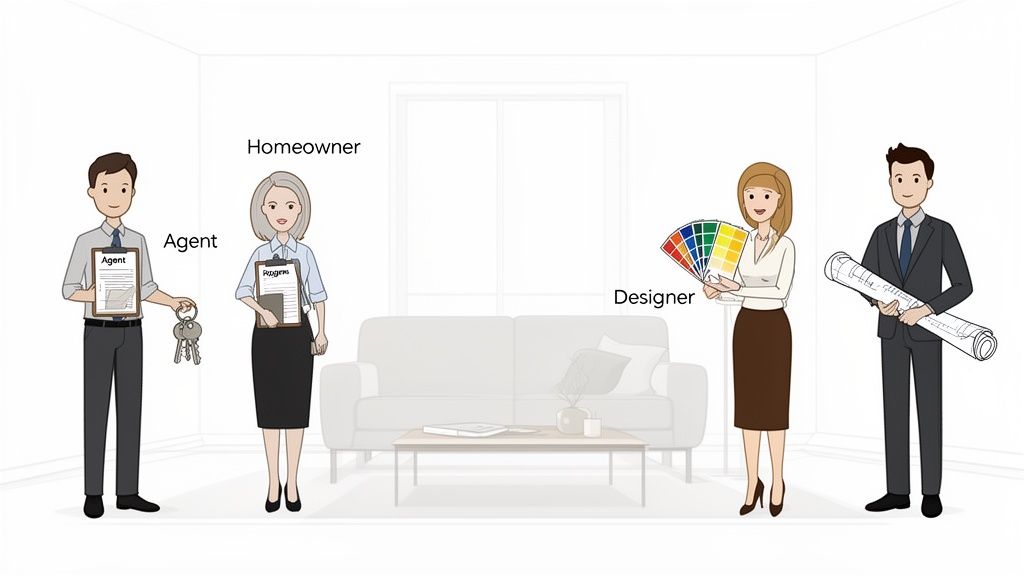
This widespread usefulness is what’s fueling some serious market growth. The real estate virtual staging service market, valued at USD 285 million in 2024, is expected to skyrocket to USD 645.97 million by 2033. That’s a compound annual growth rate (CAGR) of 11.9%.
This boom isn't just about big commercial firms. It's driven by everyone from families using simple text prompts to re-imagine their living room to architects creating high-stakes presentations with sketch-to-3D renders.
So, let's break down who really benefits from having this tech in their back pocket.
Real Estate Agents and Marketers
If you're an agent, your job is to make a buyer fall in love with a house. That’s tough to do when all they see are empty rooms that feel cold and sterile. It’s hard for most people to look at a blank slate and picture their future life there.
AI Virtual Staging completely flips that script.
Agents can take photos of a vacant listing and, almost instantly, fill them with stylish, welcoming furniture. Instead of just telling a buyer about the property's potential, you can show them.
Make Listings Pop: Transform those cold, empty photos into warm, inviting spaces that make people stop scrolling and take a closer look.
Speak to Your Buyer: You can stage a spare room as a slick home office to attract young professionals or as a cozy nursery for a growing family. The marketing becomes incredibly targeted with just a few clicks.
Sell Faster: It's a simple formula. Better photos get more views. More views lead to more showings. And more showings get you to the offer table quicker.
Using this technology helps agents put a property's best foot forward every single time. It's a powerful way to cut through the noise in a very crowded market. We've even put together a detailed guide on the benefits of virtual staging for realtors if you want to dive deeper.
Homeowners and DIY Decorators
Let’s be honest, planning a renovation or even just redecorating a room can feel daunting. You're trying to pick a paint color from a tiny swatch or choose a sofa online, hoping it all works together. It’s a big commitment, and the fear of getting it wrong is real.
AI Home Décor tools take all that guesswork out of the equation.
A homeowner can just snap a picture of their own room, upload it, and start playing. You can try out different furniture styles, experiment with bold wall colors, and rearrange layouts to your heart's content. You get a realistic preview before you spend a single dollar or lift a paintbrush.
It's like having a personal design sandbox. You can test out bold choices without any risk, ensuring you love the final look before you start the actual work.
It makes the whole process feel fun and creative again, giving anyone the confidence to make smart decisions about their space.
Interior Designers and Professional Stagers
For any design professional, time is money, and clear client communication is everything. AI Interior Design platforms are becoming an indispensable assistant, dramatically speeding up the early stages of a project.
Instead of spending days creating a single mockup, a designer can generate several distinct concepts for a client in a matter of minutes.
This kind of rapid visualization gets everyone on the same page from the get-go. A client can see concrete examples—from sleek modern to rustic farmhouse—and give you direct, actionable feedback. This efficiency frees you up to focus on the custom details and creative touches that clients are actually paying you for.
Property Developers and Builders
Trying to sell a property that doesn't exist yet is one of the toughest marketing challenges out there. You have to sell a vision, but a dusty construction site and a set of blueprints don't exactly stir the emotions.
Virtual staging AI is the perfect solution for marketing off-plan properties.
Developers can take architectural plans or photos of a half-finished space and generate stunning, photorealistic images of the completed home. Potential buyers see a finished product, beautifully furnished and decorated. It makes the project feel real and desirable, turning an abstract idea into a tangible place they can imagine living. This makes pre-sale marketing infinitely more effective.
Your Step-by-Step Guide to Using Virtual Staging AI
Ready to see how it all works? Getting started with virtual staging AI is a lot more straightforward than you might think. I'll walk you through the entire process in five simple steps, taking you from curious beginner to confident creator in just a few minutes.

This isn't about getting bogged down in tech. It's about showing you just how easy it is to produce stunning, professional-quality images that sell.
Step 1: Take the Right Photos
Your final, staged image will only ever be as good as the photo you start with. Think of it like giving an artist a clean canvas—a great source photo is the foundation for a believable, photorealistic result.
Here are a few quick tips to get the best shots:
Use Natural Light: Always try to shoot during the day when the room is at its brightest. Good lighting is key for helping the AI render realistic shadows and textures.
Find the Best Angle: Stand in a corner of the room to get the widest possible view. This gives a much better sense of the space and its potential layout.
Keep it Level: Hold your camera around chest height to avoid strange, distorted perspectives. You want the photo to feel like someone is standing naturally in the room.
A high-resolution photo from any modern smartphone will do the trick, though a professional real estate photographer will always deliver the absolute best results.
Step 2: Upload Your Image
Once you have a photo you’re happy with, the next move is to upload it to your chosen AI Virtual Staging platform. This is where the magic really starts. As the image loads, the AI immediately gets to work analyzing and mapping out the room's key features.
It identifies the walls, floor, ceiling, and windows, calculating the room's dimensions and perspective from that single 2D image. This scan is absolutely crucial because it’s what allows the AI to place furniture that is scaled correctly and properly aligned with the space.
It's helpful to think of this upload and analysis phase as the AI creating a 3D blueprint from your 2D photo. It builds a genuine understanding of the space so it can furnish it intelligently, not just paste pictures on top.
Step 3: Choose Your Design
Now for the fun part—deciding on the room's look and feel. Most platforms give you a couple of different ways to direct the AI Room Design process, making it easy to hit the perfect aesthetic for your target buyers or clients.
Style Presets: The easiest way to start is by picking from a library of pre-defined styles. Options like "Modern," "Scandinavian," or "Farmhouse" let you apply a complete, professionally curated look with just one click.
Custom Prompts: If you want more control, you can use text prompts to describe exactly what you're imagining. For instance, you could type, "A cozy living room with a grey sectional sofa, a round wooden coffee table, and a large abstract painting on the wall."
For anyone looking for a modern approach on how to plan room layout, virtual staging AI offers a powerful way to experiment with different setups and styles without moving a single piece of real furniture.
Step 4: Fine-Tune the Look
The first version the AI generates is often impressive, but it doesn't have to be the final one. Many of the more advanced platforms let you make detailed adjustments. If you love the overall vibe but want to tweak a specific element, you can easily make edits.
This might mean swapping out one armchair for another, changing the wall color, or adding small decorative items like plants and lamps. This back-and-forth process gives you the power to perfect every little detail until the room looks just right.
Step 5: Export Your Final Images
Once you’re completely satisfied with the result, the last step is to export the high-resolution image. Before you hit download, think about where you’ll be using it. Platforms often give you options for different file sizes and formats optimized for various channels.
For example, you'll want the highest quality JPEG for your MLS listing to show off every detail. For a quick post on Instagram or Facebook, a smaller, web-optimized file might load faster and work better. Just remember to add a disclosure like "Virtually Staged" to be transparent with potential buyers. For a deeper dive into technical specs, you can check out API documentation for https://decor8.ai/api-docs/virtual-staging-empty-rooms.
Advanced Features for Professionals
Once you get the hang of the basics, you'll find that virtual staging AI has a whole toolkit of advanced features. These tools take it from a simple visualization aid and turn it into a serious marketing machine, built for pros who need to solve tough visual problems on the fly.
Think of it like this: basic staging shows what a room could look like. Advanced features show what it will look like after you've dealt with its real-world problems. Whether it’s a cluttered space, a dated kitchen, or a house that’s still just studs and drywall, these tools let you present any property at its absolute best.
For agents, developers, and designers, these capabilities are non-negotiable. You're selling a vision, not just four walls. By tackling potential buyer objections before they're even spoken, you can close deals faster and for better prices.
Declutter and Redesign with Item Removal
One of the most useful advanced features is AI-powered item removal. Picture a common scenario: you have a listing where the sellers are still living in the home. It’s filled with their personal clutter and furniture that just won't resonate with today's buyers. Clearing it all out for photos is a huge headache.
With item removal, the AI scans the photo and digitally erases everything you don't want in seconds. It hands you a clean, empty canvas from a fully furnished room, ready for a fresh round of AI Virtual Staging. It's a lifesaver for:
Occupied Listings: Instantly remove family photos, clutter, and worn-out furniture.
Estate Sales: Clear out inherited belongings to highlight the home's core architecture.
Tenant-Occupied Properties: Redecorate a space virtually without disturbing the current renters.
This feature alone saves a staggering amount of time and money, making it possible to market any property beautifully, no matter what's inside it.
Visualize the Future with Virtual Renovations
But what if the property’s main issue isn't clutter, but a design that’s stuck in the past? Many buyers just can't see past shag carpet, loud paint, or a kitchen that needs to be gutted. This is where virtual renovations are a game-changer.
Advanced virtual staging AI can digitally transform a room's core elements. You can instantly change wall colors, replace old flooring with sleek hardwood, or even give the kitchen a full makeover with new cabinets and countertops. It lets you show buyers a home's true potential without spending a single dollar on construction.
By showing a "before" and "after," you’re not just selling a house—you’re selling a future-proofed home. This helps buyers connect on an emotional and financial level because they can actually see the value they're investing in.
For property developers, this is indispensable. You can take photos of unfinished construction sites and turn them into fully furnished, move-in-ready homes. This lets you kick off your marketing and sales process months ahead of schedule. You can learn more about these tools at Decor8 AI's virtual staging solutions.
Scale Your Operations with APIs and Integrations
When you're managing a large portfolio, doing things one-by-one just isn't an option. That’s why professional virtual staging AI platforms offer APIs (Application Programming Interfaces) and SDKs (Software Development Kits). These let you plug the staging technology directly into your own websites and business software.
This is a huge deal for large brokerages and property portals. The global market for virtual staging is set to explode from USD 0.57 billion in 2026 to USD 4.73 billion by 2035, and it's this kind of scalable, integrated tech that's driving the growth. Developers can easily build staging features into their WordPress or Wix sites, letting them automate the marketing for hundreds of listings at once.
Of course, virtual staging is just one piece of the puzzle. Real estate pros can also tap into a wide range of other AI tools for real estate professionals to make other parts of their business run smoother. This kind of integrated approach is where property marketing is headed.
Common Questions About Virtual Staging AI
It's only natural to have questions—and maybe even a little skepticism—about a technology as powerful as this one. When it comes to virtual staging AI, getting into the nitty-gritty is the best way to use it effectively and ethically. Let's tackle some of the most common questions head-on to give you the clarity and confidence you need.
Think of this as your practical guide for navigating the details, from making sure the final images look real to understanding the rules of the road.
How Realistic Does AI Virtual Staging Actually Look?
This is usually the first thing people ask, and for good reason. The short answer? It can look astonishingly real. We've come a long way from the days of simply cutting and pasting clip-art furniture into a photo. Today's AI is much, much smarter than that.
Modern AI Virtual Staging platforms don't just add furniture; they integrate it. The software analyzes the room's lighting, maps out where shadows should naturally fall, and understands the camera's perspective. This allows it to place a virtual sofa or dining table into the scene so it looks like it truly belongs there.
The best systems can render incredibly fine details—the texture of a fabric couch, a subtle reflection on a glass coffee table, or the soft glow cast by a lamp. When it’s done right, the result is often completely indistinguishable from a photo of a traditionally staged room.
Of course, the quality of your original photo is key. A high-resolution, well-lit picture of a clean, empty room gives the AI the perfect canvas to work its magic. A blurry, dark photo will always hold back the final result, no matter how good the AI is.
Is It Ethical to Use AI Staging in Real Estate Listings?
Absolutely, as long as you're transparent about it. Using virtual staging is a widely accepted and ethical marketing practice, but the golden rule is disclosure. You wouldn't try to hide a leaky roof, and you shouldn't try to pass off a virtually staged photo as the real thing.
Most real estate boards and MLS services have clear guidelines requiring any digitally altered images to be labeled as such. A simple watermark or a quick note in the photo caption that says "Virtually Staged" is typically all you need. This simple step is crucial for maintaining trust with potential buyers.
Remember, the goal of staging was never to mislead anyone. It’s about helping buyers bridge the "visualization gap"—that common struggle to see the potential hiding in an empty, echoing space.
It’s a Marketing Tool: Think of it like professional photography that uses great lighting or minor color adjustments to show a home at its best. It enhances, it doesn't deceive.
It Shows Potential: AI Home Design helps buyers imagine their own lives unfolding in the space, creating an emotional connection that an empty room just can't.
It Sets Expectations: By clearly stating that the home is virtually staged, you ensure buyers aren't surprised or disappointed when they tour the property in person.
Used responsibly, virtual staging is a powerful and ethical tool that helps both sellers and buyers.
Can I Use This for My Own Home Renovation Projects?
You bet. Virtual staging AI isn't just for real estate pros. It’s an incredible tool for any homeowner who's planning a renovation or even just a simple redecorating project. We've all felt that fear of making a costly design mistake, like picking the wrong paint color or buying a sofa that completely swallows the room.
AI Home Décor features take all that guesswork and anxiety out of the equation. Just upload a photo of your own room and start experimenting, completely risk-free.
Test Paint Colors: Virtually paint your walls with real colors from major brands to see how they look with your home's specific lighting.
Experiment with Layouts: Drag and drop furniture to try out different arrangements and find what’s most functional and beautiful.
Explore Different Styles: See if that minimalist vibe you love on Pinterest actually fits your living room before you spend a dime.
This technology gives you the power to visualize your ideas with stunning accuracy. It’s like having your own personal design playground, helping you make decisions you feel great about and ensuring the final result is exactly what you hoped for.
Ready to transform your empty rooms into beautifully furnished spaces? Decor8 AI offers an all-in-one platform to create stunning, photorealistic designs in seconds. Start your free trial today and see the difference for yourself at https://www.decor8.ai.
Comments