
A Practical Guide to Interior Design With AI
Ever wondered what your living room would look like with a completely different style, but felt stuck just trying to picture it? That’s where AI interior design comes in. It’s a way to use artificial intelligence to instantly generate photorealistic design ideas for your actual space.
You simply upload a photo of your room, describe what you’re looking for, and an algorithm creates countless design variations in seconds. Instead of just imagining how new furniture or a fresh coat of paint might look, you can see it right in front of you. This makes professional-level design fast, affordable, and genuinely accessible to everyone.
How AI Is Changing Interior Design
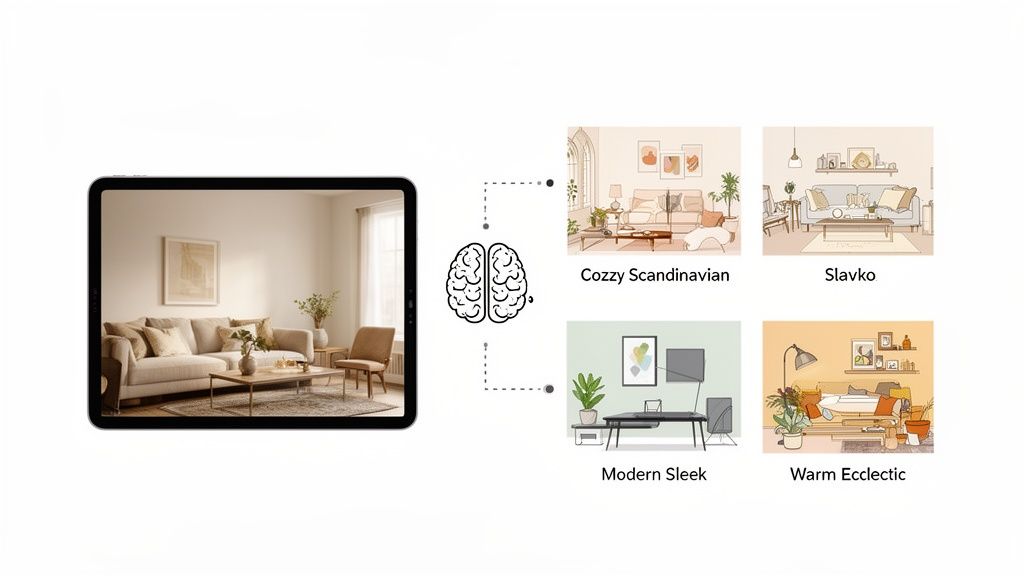
Think of having a creative partner who never gets tired, never runs out of ideas, and can show you exactly how each one will look in your home—instantly. That's the real magic of what interior design with AI offers. We're moving way beyond old-school mood boards and piles of fabric swatches and into a world of immediate, visual feedback.
It's like having a smart assistant for your home. You feed it a picture of a room and the AI becomes your personal designer. You can give it simple commands like, 'make this living room cozy and Scandinavian,' or 'show me this space with a minimalist vibe and dark wood accents.'
The AI gets to work analyzing your photo—it understands the room's layout, lighting, and existing features. Then, it generates stunningly realistic images of the transformed space. The whole thing happens in moments, not the weeks it would traditionally take.
The Power of AI Room Design
This new approach is completely shaking up how we tackle decorating and renovations. You're no longer limited by your own imagination or the tedious process of creating manual mockups. AI Room Design tools give you the freedom to explore possibilities you might never have thought of on your own.
Here’s a quick rundown of what this means for you:
Endless Inspiration: You can generate dozens of unique concepts for a single room, whether you want a tiny tweak or a complete overhaul.
No Technical Skills Needed: These tools are built to be intuitive. If you can upload a photo and type a sentence, you have all the skills you need.
Visualize Before You Commit: See exactly how that bold paint color, new sectional, or different layout will look before you spend a dime or pick up a paintbrush.
At its heart, AI interior design is about taking the guesswork out of the equation. It closes the gap between a vague idea in your head and a fully realized visual, giving you the confidence to make great design decisions.
From Simple Photos to Photorealistic Concepts
The technology doing the heavy lifting is complex, but the experience for you is incredibly simple. The AI analyzes the pixels in your photo to identify the walls, floors, windows, and furniture. When you give it a prompt, it uses this spatial awareness to realistically add new items, change colors, and even adjust lighting and shadows.
This kind of power isn't just for the pros anymore. Anyone can now tap into these tools to bring their vision to life and experiment with different styles, layouts, and decor risk-free. It's also a fantastic way to understand the future of interior design trends to watch by seeing them applied directly to your home.
This shift makes creating a beautiful, functional space less about technical skill and more about pure creativity, kicking off a whole new era of home styling.
Why You Should Use AI for Home Design
Sure, AI can generate some stunning images, but its real value in home design is far more practical. It's about helping homeowners, real estate agents, and design pros make smarter decisions, save a ton of money, and explore creative ideas that used to be out of reach.
For homeowners, the biggest win is saying goodbye to guesswork. Ever painted a room, only to realize you hate the color once it's dry? Or bought a sofa that looked amazing in the store but completely swallowed your living room? AI puts an end to that expensive, frustrating cycle.
With an AI Room Design tool, you can see exactly how a change will look in your own space before you spend a dime. Test out a dozen paint colors, shuffle furniture layouts, or see if that bold, trendy wallpaper actually works with your floors. It’s the ultimate "try before you buy" for your home, giving you the confidence to pull the trigger on a project.
Speed Up Real Estate Sales with AI Virtual Staging
In real estate, the impact is huge. An empty house is a blank canvas, but for many buyers, it’s just… blank. It’s hard for them to picture their own furniture, their own lives, unfolding within four empty walls.
This is where AI Virtual Staging completely changes the game. Forget the cost and headache of renting physical furniture. Agents can now digitally stage an entire property in minutes. This helps potential buyers connect with a listing emotionally, seeing it not as an empty box but as a welcoming home. Great visuals don't just get more clicks—they build a connection that often leads to faster sales and stronger offers. For more ideas, check out these 10 ways AI can transform your empty space into a dream home.
A Creative Partner for Professional Designers
Even seasoned designers are embracing these new tools. Think of an AI Home Design platform as a creative co-pilot. It handles the repetitive, time-consuming tasks, like churning out initial concepts for a client presentation. A designer can generate a dozen different looks in the time it used to take to manually render just one.
AI doesn't replace a designer's expertise; it amplifies it. By handling the rapid visualization, it frees up professionals to focus on the human side of design—client relationships, project management, and adding those personal touches that truly make a space sing.
The industry is already voting with its feet. The global AI interior design market, valued at USD 829 million in 2023, is expected to skyrocket to USD 7,299 million by 2033. With nearly 47% of design professionals already using AI, it’s safe to say these tools are no longer a novelty but a core part of the modern workflow, according to a recent market analysis on AI interior design.
At the end of the day, platforms like Decor8 AI are making good design accessible to everyone. They give powerful visualization tools to anyone with an idea, making it easier and more affordable to create spaces that aren't just beautiful, but are a perfect reflection of the people in them.
Your First AI Interior Design Project
Jumping into your first project with AI interior design is a lot more intuitive than you might think. Forget about needing complex software skills or a technical background—this is all about a straightforward, creative process. Let's walk through how you can go from a simple photo of your room to a polished, professional concept.
The whole journey starts with one crucial element: your "before" photo. A good picture is the foundation for a great result.
Capturing the Perfect "Before" Photo
To get the most realistic outcomes, you need to give the AI a clear, honest look at the space. The best way to do this is to stand in a corner, which lets you capture as much of the room as possible in a single shot. Make sure the room is well-lit, ideally with natural light, to avoid strange shadows that can throw the AI off.
Hold your phone or camera steady and straight. Photos that are taken at a weird angle or are distorted will only lead to skewed results. Think of it like taking a picture for a real estate listing—the clearer and more complete the photo, the better the canvas for your AI Home Décor ideas. For a full breakdown, our guide on AI room design from a photo dives into even more detail.
Creating a Clean Slate
Once your photo is uploaded, the next step is to prep the space for its makeover. Most quality AI tools, including Decor8 AI, have features that let you digitally "empty" the room. With just a few clicks, you can zap away old furniture, clear out the clutter, and even erase unwanted pictures from the walls.
This step is critical because it gives the AI a truly blank canvas to work with. It prevents the old décor from bleeding into the new design, so the concepts you get are genuinely fresh and aligned with what you actually want. You're not just redecorating; you're starting from scratch, digitally.
Bringing Your Vision to Life with Prompts
Now for the fun part. You’ve got two main ways to generate a new design. The first is to use pre-set styles. Platforms like Decor8 AI have a whole library of popular aesthetics—think ‘Modern Farmhouse,’ ‘Industrial,’ or ‘Bohemian’—that you can apply instantly.
The second, and more powerful, method is to write your own text prompt. This is where you get to be the director. Instead of just picking a style off the shelf, you describe exactly what you want to see.
Think of a good prompt as having a conversation with a real designer. The more specific you are, the better the AI can interpret your vision and deliver something that actually matches what's in your head.
For instance, instead of a generic "modern living room," try something more descriptive like:
"A bright, minimalist living room with a large grey sectional sofa, a light oak coffee table, and a single large abstract painting on the main wall."
This simple workflow—visualize, save, and create—is really the heart of the entire AI Interior Design process.
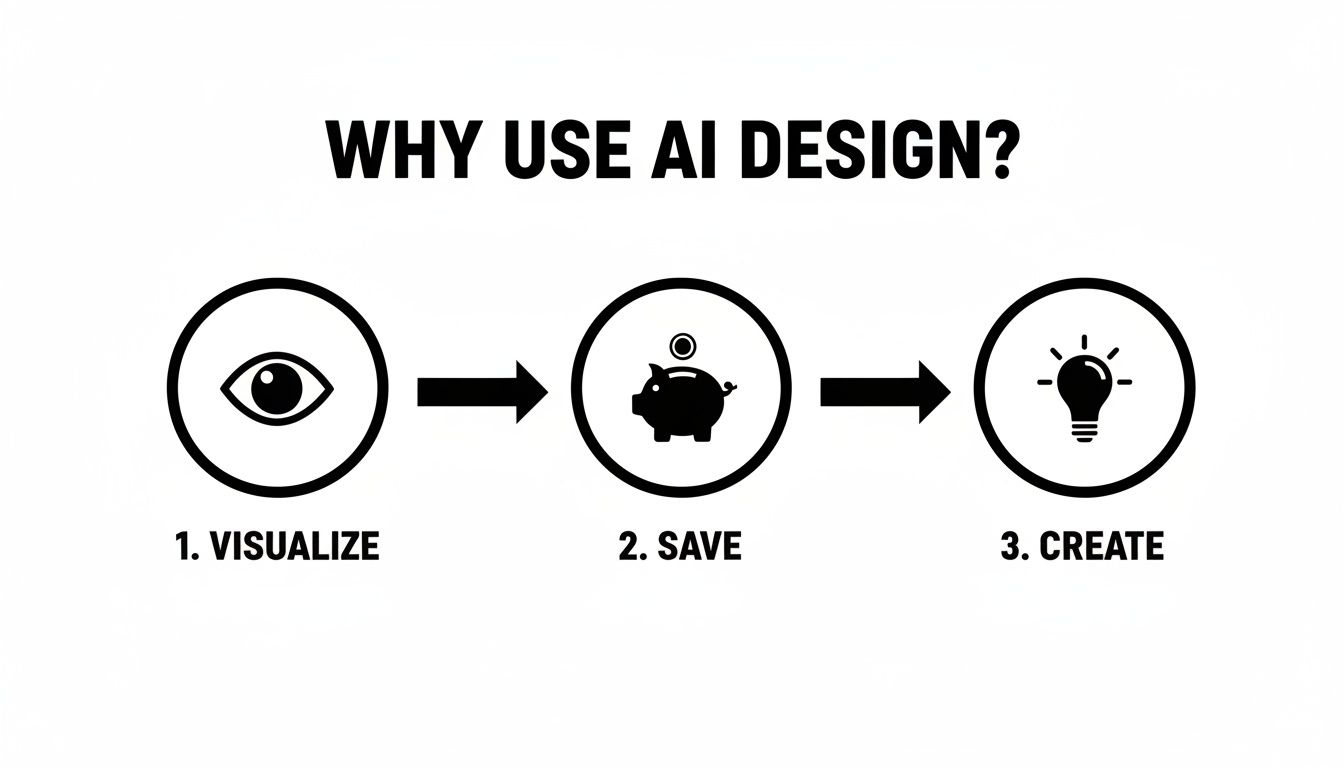
This flowchart neatly sums up the core benefits, showing how AI helps you see your ideas, save money, and come up with new concepts you might not have thought of otherwise.
Refining and Perfecting Your Design
The first design you get is rarely the final one. The real magic is in the iteration. You can tweak and refine the design using simple, conversational commands. See a rug you like, but it’s the wrong size? Just tell the AI, "make the rug larger." Want the room to feel a bit sunnier? Try, "add more natural light."
You can even bring real-world products into the mix. For example, you can virtually "paint" the walls with specific colors from brands like Sherwin-Williams or Benjamin Moore to see exactly how they’ll look in your space. When you land on a design you love, just upscale it to a high-resolution image, perfect for sharing with your contractor, family, or just for your own inspiration board. This whole process gives you the confidence to kick off your own AI-powered makeover.
Practical Applications of AI Interior Design
The theory behind interior design with AI is interesting, but where it really shines is in solving real-world problems for real people. Whether you're a homeowner staring at a blank wall or a developer marketing a high-rise, AI is quickly becoming an essential part of the toolkit. This isn't just a fun new toy; it's a practical way to get things done faster, with more clarity and a whole lot more creativity.
For The Homeowner and DIY Enthusiast
Let’s say you’re gearing up for a full kitchen remodel. The number of decisions is overwhelming: cabinet colors, countertop materials, tile patterns. Instead of spending weeks taping paint chips to the wall or hoarding samples, an AI Room Design tool lets you see the finished product in minutes. Just snap a photo of your current kitchen, and you can instantly cycle through dozens of variations, landing on the perfect look before you even talk to a contractor.
Even for something as simple as repainting a room, AI takes the guesswork out of the equation. You can test out real paint colors from all the major brands on your own walls, seeing exactly how they’ll look in your home’s natural light. It’s a simple way to avoid a costly mistake. It’s also the perfect tool for discovering an AI Home Décor style that truly fits you before you buy a single piece of furniture.
For The Real Estate Professional
In real estate, you only get one chance to make a first impression. Empty rooms just don't capture a buyer’s imagination; they feel cold and impersonal, making it hard for someone to picture their life there. This is where AI Virtual Staging completely changes the game.
An agent can now take a photo of an empty listing and have it fully furnished in minutes, all for a tiny fraction of the cost and hassle of traditional staging. A vacant, uninviting space becomes a warm, welcoming home that people can connect with. But it’s not just for empty properties:
Digital Decluttering: For homes that are still occupied, AI can digitally remove clutter and personal items from listing photos, creating a much cleaner look without making the seller move a thing.
Photo Enhancements: It can even perform tricks like sky replacement, turning a photo taken on a gloomy day into one with a bright, sunny sky.
When you help a buyer form an emotional connection to a property before they even walk through the door, you can shorten sales cycles and attract better offers. It's that simple.
AI also opens up new avenues for marketing. Beyond just static images, agents can now create immersive visual content, like compelling AI real estate videos for cinematic tours, to make their listings truly stand out.
For The Professional Interior Designer
Interior designers shouldn't see AI as a threat, but as a powerful creative partner. It takes on the grunt work of generating initial concepts, which frees them up to focus on the things that truly require a human touch—like building client relationships and managing the complex details of a project.
Imagine being able to show a client ten different design directions in a single meeting, getting immediate feedback that moves the project forward. A designer can even take a rough sketch and instantly turn it into a photorealistic rendering. This ability to visualize ideas on the fly is incredible for bridging the communication gap and making sure everyone is on the same page from day one. To see how this works in practice, check out our guide on AI virtual staging.
For The Property Developer
Developers often have to sell units long before a building is finished. It’s tough to market a vision when all you have to show are photos of a construction site. An AI Home Design tool can take pictures of those raw, unfinished spaces and transform them into stunning visualizations of the final product.
This allows them to create marketing materials that show buyers exactly what they’re getting. They can showcase different finish packages and furniture layouts to build excitement and lock in sales months, or even years, before anyone can move in.
The commercial impact here is huge. The virtual interior design market is on track to hit USD 18.06 billion by 2031, and for some commercial projects, AI is already cutting design-to-installation timelines by as much as 30%.
Choosing the Right AI Design Tool
Now that you know what's possible with AI interior design, the next step is finding the right tool for the job. The market is exploding with options, and it’s easy to get lost. Some tools are fantastic for creating artistic, dreamy concepts, while others are built from the ground up for practical, real-world projects. The trick is to find one that does both—combining powerful features with a workflow that just makes sense.
This is where a platform like Decor8 AI really shines. Think of it as a complete toolkit that closes the gap between a spark of inspiration and a finished project. Instead of bouncing between different apps for different needs, you get everything you need in one place.
An All-In-One Creative Hub
Decor8 AI is built to see you through the entire design journey. Its flagship AI Virtual Staging feature is a perfect example. Real estate pros can take an empty room and furnish it with stunning, photorealistic quality, complete with lighting and shadows that look completely real. That one feature alone can change how a property shows up online, making it a must-have for modern real estate marketing.
But it goes way beyond just staging. For homeowners and designers, the integration with real paint brands like Benjamin Moore, Sherwin-Williams, and Behr is a massive win. You can try out hundreds of actual paint colors on your walls or kitchen cabinets instantly. No more buying a dozen sample pots and painting little squares all over your house.
Decor8 AI isn’t just about making pretty pictures; it’s about providing practical solutions that solve common design challenges, save money, and give you the confidence to move forward.
Unique Features for Every Design Challenge
What really makes Decor8 AI stand out is its collection of specialized tools that target specific headaches in the design process. These aren't just gimmicks; they elevate the platform from a simple AI Room Design generator to a professional-grade suite.
Sketch-to-3D Rendering: Got a napkin sketch or a floor plan? Turn it into a polished 3D rendering in either perspective or isometric view. This is a lifesaver for architects and designers who need to visualize a concept on the fly.
Seasonal Décor Generation: Thinking about the holidays? Instantly see what your living room would look like decked out for Christmas or another season. It makes planning your AI Home Décor fun and easy.
Touch-Up Tools for Construction Sites: Developers can snap photos of an unfinished space—think exposed drywall and bare floors—and generate images of the fully finished room. It's a brilliant way to pre-sell units.
This powerful feature set is a big reason why the global interior design software market, valued at USD 5,373.8 million in 2024, keeps growing. As online furniture retailers adopt AI visualization, tools like Decor8 AI give shoppers the ability to see how a new sofa will look in their own living room before clicking "buy." You can dig deeper into these interior design software market trends to see how the industry is evolving.
Seamless Accessibility and Business Integration
A great tool doesn’t do much good if it’s a pain to use. Decor8 AI is available on iPhone, Android, and web browsers, and cloud sync means your projects are always right where you left them, no matter the device. That kind of flexibility is key, whether you’re a homeowner tweaking a project on your commute or a designer presenting concepts in a client meeting.
For businesses that want to bake this technology into their own platforms, Decor8 AI offers some serious power. The company provides a full API and SDKs (in Python, JavaScript, Dart, and HTTP), letting you build AI Home Design features directly into your own website or app.
Better yet, for those without a team of developers, there are ready-made plugins for platforms like WordPress, Wix, and Bubble. This makes it incredibly easy to add virtual staging or design visualization to your site. It’s clear Decor8 AI has not only mastered the fundamentals of AI Interior Design but also built a scalable, professional-grade solution ready for any challenge.
Common Questions About AI Interior Design
Jumping into any new technology can feel a little confusing, and AI interior design is no different. It’s totally normal to have questions about what it can do, where it falls short, and how it actually fits into a real creative process. Let's walk through some of the most common questions to help you get started with confidence.
Most people’s first question is a big one: can a machine really get something as personal and nuanced as style? There's a fear you'll just end up with generic, cookie-cutter designs that look like everyone else's.
Can AI Truly Understand My Personal Style?
Absolutely, and this is where the magic really happens. While an AI Interior Design tool can easily start with broad styles like "Mid-Century Modern" or "Coastal," its true strength is how it listens to your specific instructions.
Think of it like having a conversation with a design assistant. You guide the AI toward your vision by adding layers of detail in your text prompts. For instance, instead of just asking for a "modern living room," you could try something like: "a bright and airy modern living room with a plush velvet sofa, gold accents, and a large abstract art piece." The more you tell it, the closer the AI Home Décor gets to what’s in your head.
For an even more direct approach, many platforms let you upload an inspiration photo. The AI analyzes that image—the colors, the furniture, the overall vibe—and applies that same aesthetic to your room. It’s a fantastic way to ensure the final concept is perfectly in sync with what you already love.
Is AI Interior Design Expensive or Difficult to Use?
Not at all. In fact, one of its biggest selling points is how accessible it is. Good platforms are built for regular people, not tech wizards. They have simple, clean interfaces that don't require any special skills. If you can upload a photo and type a sentence, you’re ready to go.
On the financial side, it’s a total game-changer. Many tools have free trials or super affordable subscription plans, letting you brainstorm countless ideas without breaking the bank. Compare that to the cost of hiring a traditional designer for initial concepts or paying for physical home staging, and you’ll see that AI Room Design is an incredibly cost-effective way to get started.
Will AI Replace Professional Interior Designers?
This is a hot topic in almost every creative field, but the consensus is clear: AI is a powerful assistant, not a replacement. Think about what takes up so much of a designer’s time—generating dozens of initial ideas and creating visualizations. AI is fantastic at that.
By handing off that initial legwork, AI frees up designers to focus on the human parts of the job. Things like building a real connection with a client, managing the complex logistics of a project, and understanding the subtle needs of a space that a machine just can't see. More and more, designers are using these tools to supercharge their services, present ideas more vividly, and simply work smarter. To see how this works behind the scenes, check out our guide on how AI design prompts actually work.
How Realistic Are the Images Generated by AI?
The realism has gotten shockingly good. Modern AI platforms are trained on massive libraries of beautiful interior photos, and they've learned to replicate incredibly convincing lighting, shadows, and textures.
This isn't just a cool feature anymore; it's essential. For a real estate agent, the visuals need to be compelling enough for a buyer to imagine themselves living there.
The best tools are now producing AI Virtual Staging visuals that are often hard to tell apart from professional photography. This helps a property pop online and allows potential buyers to see a house not just as it is, but as their future home. The technology has come so far that the results aren't just inspiring—they're truly believable.
Ready to stop wondering and start seeing? With Decor8 AI, you can transform your space in seconds. Just upload a photo, describe your dream room, and watch our AI bring it to life. Give it a try for free at https://www.decor8.ai and discover the future of interior design.
Comments