
Ai Virtual Staging: Transform Listings and Sell Faster with AI
Think of AI virtual staging as the digital-age answer to the old, clunky method of staging homes. Instead of renting trucks, hauling furniture, and spending weeks arranging a physical space, you can now use artificial intelligence to digitally furnish photos of empty rooms. The result? Beautifully staged, move-in-ready spaces created in minutes, not weeks.
Why Physical Staging Is Fading Out

Let's face it: traditional home staging is a massive headache. For real estate agents and sellers, it’s expensive, slow, and rigid. You're stuck coordinating furniture rentals, movers, and designers, all before you can even think about scheduling a photoshoot.
This old-school approach eats up your budget and your calendar. Costs can quickly balloon into thousands of dollars for just a couple of rooms, and the whole ordeal can take weeks from start to finish. In a market where speed matters, that’s a delay you can't afford.
A Smarter Way to Sell in a Digital World
Making the switch from physical staging to AI virtual staging is like ditching a paper map for a live GPS. It’s a complete upgrade. You’re no longer wrestling with sofas and coffee tables; instead, you can instantly turn photos of empty rooms into stunning, fully furnished spaces that stop buyers in their tracks online.
This technology directly solves the "empty room problem." Vacant properties often feel sterile and uninviting, leaving buyers struggling to imagine themselves living there. With the help of powerful AI Interior Design, you can completely change that first impression.
Forge an Emotional Connection: A warm, well-designed space helps buyers immediately connect with the property on an emotional level.
Showcase the Possibilities: You can help buyers see how their own furniture might fit by illustrating the scale and potential of each room.
Dominate Online Listings: In a crowded market, professionally staged photos are the key to grabbing attention and earning more clicks.
The real advantage here is simple: you get to show every single property in its best light, without the high costs or logistical nightmares. You’re not just hoping buyers can see past the empty walls—you're actively shaping their first, and most critical, impression.
A Game-Changer for Cost and Speed
The difference in cost and time is staggering. Physical staging can be upwards of 90% more expensive than its digital counterpart. While a traditional stager might bill you for thousands, an entire home can be virtually staged for a small fraction of that cost. Our in-depth cost analysis shows just how much you can save.
This efficiency means agents can afford to stage every listing, not just the luxury ones. It gives your whole portfolio a consistent, high-end look and a serious competitive edge.
To put it in perspective, here’s a quick comparison of the two methods.
AI Virtual Staging vs Traditional Physical Staging
This table breaks down the core differences between the old way and the new way.
Feature | Traditional Physical Staging | AI Virtual Staging |
|---|---|---|
Cost | High (thousands per property) | Low (a small fraction of physical) |
Speed | Slow (days to weeks) | Fast (minutes to hours) |
Flexibility | Low (one style, physical changes needed) | High (endless styles, instant revisions) |
Logistics | Complex (rentals, movers, designers) | Simple (upload a photo) |
Scalability | Difficult (limited by inventory/staff) | Easy (stage unlimited properties at once) |
As you can see, the choice is pretty clear. With AI, you can create inspiring visuals in minutes, giving every single home the top-tier marketing it deserves.
So, How Does AI Virtual Staging Actually Work?
You might be wondering what's going on behind the scenes with AI virtual staging. It sounds incredibly complex, but the process is actually pretty straightforward. Don't think of it as some mysterious black box—it’s more like having a lightning-fast interior designer on call who can perfectly furnish any room in a matter of seconds.
At its core, the technology runs on something called generative AI. These aren't just fancy photo editors; they're creating entirely new visual content from scratch. The AI models have been trained on enormous datasets packed with millions of high-quality photos of real interiors, furniture, and decor across every imaginable style.
Through all that training, the AI learns the fundamentals of good interior design. It picks up on spatial relationships, color theory, how light behaves in a room, and which pieces of furniture work well together. This deep understanding is what allows it to generate images that are not just realistic, but also genuinely appealing to potential buyers.
The Three-Step Process
Most AI Room Design platforms are designed to be incredibly user-friendly. They typically break the whole thing down into three simple steps, so you don't need a design degree to get professional-looking results.
Upload Your Photo: It all starts with a good, clear picture of an empty or cluttered room. The better the photo, the better the final result. A high-quality image gives the AI more information to work with, which helps it create a much more convincing final image.
The AI Gets to Work: Once your photo is uploaded, the AI starts its analysis. It maps out the room's key features—the walls, floors, and ceiling—and figures out its dimensions. Critically, it also detects the existing light sources, which is the secret sauce for making the final image look real.
Generate and Refine: Finally, the AI places photorealistic furniture and decor into your photo. You pick a style—like Modern Farmhouse, Scandinavian, or Industrial—and the AI pulls from its massive digital library to arrange items in a way that looks both beautiful and functional.
The real game-changer is how the AI renders these digital items to look like they're actually in the room. It ensures a shadow from a virtual couch falls exactly right based on the room's natural light, or that the reflection on a glass coffee table correctly mirrors a window.
Making It Your Own
The best platforms don't just stop there. They also give you tools to tweak the results and put your own spin on things. For example, you can use simple text prompts to direct the AI, like, "Stage this living room in a cozy, minimalist style with a large neutral-colored sectional and warm wood accents." It’s the perfect blend of AI speed and human creativity.
This technology isn't just about adding furniture, either. Many tools let you perform virtual renovations. You can digitally paint the walls a new color, swap out old carpet for hardwood floors, or even update kitchen cabinets—all in a few clicks. This is a huge part of what makes AI Home Design so powerful, as it helps buyers see a property's potential, not just its current condition.
To dive deeper into the nuts and bolts, check out our detailed guide on how AI virtual staging works. It's this fusion of smart analysis and creative control that makes AI staging an essential tool for anyone in real estate today.
The Real-World Impact on Your Listings
Let's get down to what really matters: results. It's one thing to create a beautiful picture, but AI virtual staging is about much more than just looks. It’s a powerful tool that delivers a measurable return on your investment, driving real business outcomes for agents and sellers. The data is clear—this isn't just a cosmetic touch-up; it's a critical sales asset.
When you add AI-staged photos to your marketing, you gain a serious competitive edge. Listings with these visuals don't just look better; they perform better. We're talking more attention, more qualified leads, and properties that sell faster.
The whole process is surprisingly simple, usually just three steps from start to finish.
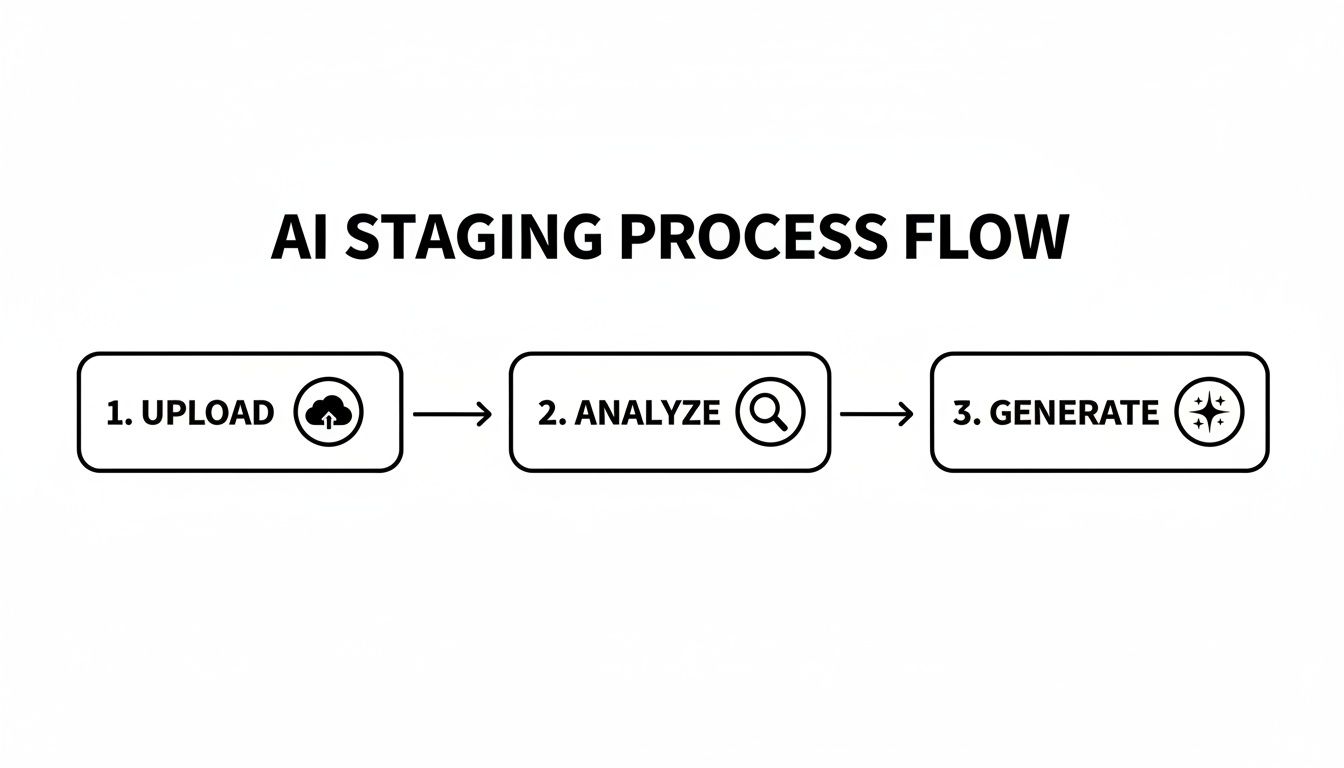
This workflow is built for speed and ease of use, putting professional-grade results within anyone's reach.
Boosting Online Views and Qualified Inquiries
Think about it: the first showing isn't in person anymore, it’s online. An empty room is a blank slate, sure, but it's also a missed opportunity. It rarely creates the emotional spark that makes a buyer stop scrolling and book a tour. By using AI Home Design to show off a property's true potential, you can massively increase its appeal right from that first click.
A well-staged photo stops the scroll. It helps a potential buyer instantly visualize a property as their future home, transforming them from a passive browser into an engaged lead. This is the first and most important step in the sales funnel.
The numbers don't lie. Real estate pros who use these tools see a major lift in buyer engagement. For instance, listings that feature AI virtual staging can pull in a 72% increase in online traffic compared to their empty-room counterparts. That jump in views also brings a 44% uptick in qualified inquiries, which means you're attracting more serious buyers who are ready to take the next step.
Accelerating Sales and Increasing Prices
More traffic is great, but the real goal is to sell the property—fast and for the best price. This is where AI-powered staging truly shines. How you present a home has a direct impact on how quickly it sells and for how much.
Faster Sales Cycles: Staged homes just sell faster. The data shows that virtually staged properties sell approximately 75% faster than unstaged ones. That means fewer days on the market, lower carrying costs for sellers, and a quicker commission check for you.
Higher Sale Prices: Staging doesn't just speed things up; it adds to the bottom line. Virtually staged homes often sell for 5% or more above the asking price, with some reports showing premiums anywhere from 1% to 10%. That makes the small cost of AI staging an incredibly smart investment.
Winning More Listings: A top-tier marketing plan is your best tool for attracting new clients. Agents who use advanced staging platforms have been shown to win 30% more listings than their competition. It’s proof that a modern digital strategy is a powerful way to grow your business.
These numbers tell a compelling story. The small upfront investment in AI virtual staging generates a huge return, not just on one sale, but across your entire business. To learn how to put these strategies to work, take a look at our complete real estate agent's guide to virtual staging.
Gaining a Definitive Competitive Advantage
In a crowded market, standing out is everything. Offering AI virtual staging as part of your standard marketing package immediately separates you from agents still showing photos of empty rooms. It tells sellers you're using every modern tool available to maximize their property's value.
This proactive approach signals a commitment to high-quality marketing and getting the best results for your clients. It positions you as a forward-thinking expert who knows how to capture the attention of today's digital-first buyers. At the end of the day, it's not just about selling one house—it's about building a reputation for excellence that brings in more clients and closes more deals.
Your Practical Guide to Creating Stunning Images
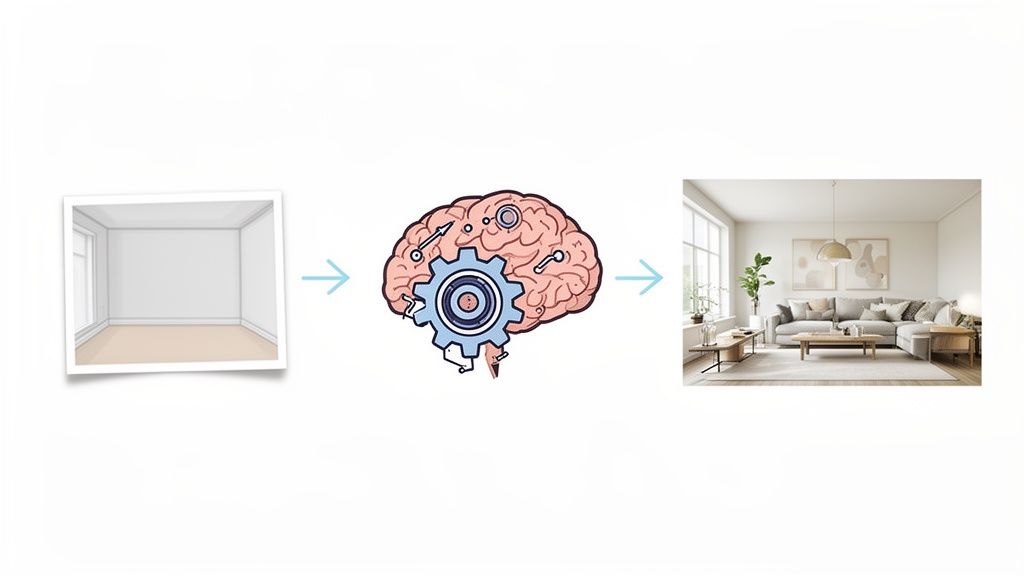
So, you're ready to create visuals that grab a buyer's attention and won't let go? Using an AI virtual staging tool is surprisingly straightforward. It puts some serious design power right at your fingertips.
This guide will walk you through the whole process. We'll start with getting the right photo and finish with a polished, listing-ready image that tells a story and helps sell the space. The best part? It's designed to be quick and intuitive, so you can skip the steep learning curve that comes with most design software.
Start With a High-Quality Foundation
This is the most critical step, and I can't stress it enough: start with a great photo. The AI is smart, but it's not a miracle worker. Its ability to create a realistic result is completely dependent on the quality of the image you feed it.
Think of it like this: you're giving the AI a canvas to paint on. A clean, crisp canvas will lead to a masterpiece. A blurry, dark one? Not so much.
For the best results, your photo should be:
High-Resolution: You need sharp details, not fuzzy pixels. A clear image allows the AI to accurately understand the room's dimensions and blend in the virtual furniture so it looks like it's really there.
Well-Lit: Natural light is your best friend. Take photos during the day to get a bright, evenly lit space. This helps the AI create believable shadows and reflections, which is key for realism.
Shot From the Right Angle: Stand in a corner or a doorway. This gives you the widest possible view, helping potential buyers get a real feel for the room's layout and size.
Key Insight: The golden rule of AI-powered design is "quality in, quality out." A blurry, dark, or awkwardly angled photo will hold the AI back. A clean, professional shot unlocks its full potential.
Once you have that perfect photo, the real fun begins.
Master the Art of the Prompt
At the heart of any AI Interior Design platform is the prompt—that's the text command you give the AI. A good prompt is like a creative brief for your digital designer; it guides the AI to generate exactly what you have in mind. While most tools offer pre-set styles, writing your own prompt gives you total control.
Start with a clear, descriptive command. Include the room type, the style you're going for, specific furniture, and even a color scheme. The more specific you are, the better the AI can narrow down the possibilities and give you a spot-on result.
For example, don't just say, "make this look nice." Instead, try something with more detail:
For a living room: "Stage this living room in a modern farmhouse style with a comfortable gray sectional sofa, a rustic wood coffee table, and blue accent pillows."
For a bedroom: "Create a cozy Scandinavian bedroom with a king-sized bed, light wood nightstands, and plush white textiles."
For a kitchen: "Update this kitchen with white shaker cabinets, a marble backsplash, and stainless steel appliances."
See the difference? These detailed instructions give the AI clear direction. Don't be afraid to play around with different prompts to see what works best for your space.
Refine and Iterate for Perfection
Your first attempt might not be perfect, and that's completely normal. It's all part of the process. The best AI virtual staging tools are built for iteration, letting you refine the results until they're just right. Think of it as a conversation—you give feedback, and your digital designer makes adjustments.
Many platforms will let you generate several different versions from a single prompt. This is fantastic for comparing different furniture layouts or color schemes side-by-side. If a couch looks out of place, you can often ask the AI to swap it for something else or try a new style entirely.
Plus, many tools offer advanced AI Room Design features that go way beyond just adding furniture. You can:
Change Wall Colors: See how a room looks with a fresh coat of paint in seconds.
Update Flooring: Swap out that dated carpet for virtual hardwood or tile.
Remove Existing Clutter: Use an "item removal" tool to get rid of old furniture or personal belongings, giving you a clean slate to work with.
If you want to see this in action, the best way to learn is by doing. You can experiment with a free AI interior design tool to add furniture to empty rooms. Getting hands-on is the quickest way to understand what these tools are capable of and get confident in creating your own amazing images.
The Future of Property Marketing Is Here
AI virtual staging is no longer just a clever trick for real estate listings. It’s rapidly becoming a go-to tool for a whole host of professionals in the property and design worlds, fundamentally changing how we all visualize and market spaces.
We're seeing a major shift here. This isn't just a fleeting trend; AI-powered design is cementing its place as a core part of the modern toolkit for anyone who deals with physical spaces. It’s reshaping workflows from the earliest design concepts all the way to the final marketing push.
More Than Just Real Estate Listings
Real estate agents might have been the first to jump on board, but they’re certainly not the only ones anymore. Professionals from across the industry are finding new and creative ways to use this tech to up their game and connect with clients.
Interior Designers: Imagine showing a client three completely different design concepts for their living room in just a few minutes. That's what AI Interior Design makes possible, turning a slow, manual process of creating mood boards into an interactive, collaborative session.
Homeowners and DIY Enthusiasts: Anyone planning a renovation can now use AI Home Design to see exactly how that new paint color or furniture arrangement will look. It takes the expensive guesswork out of redecorating.
Builders and Developers: Marketing a property that doesn’t exist yet is tough. Now, they can generate beautiful, realistic images of a home long before the foundation is even poured, helping them sell off-plan and secure buyers much earlier.
When a single tool starts solving problems for such a wide range of people, you know it's here to stay. It's moving from a niche product to an industry standard.
And the market growth? The numbers tell an even bigger story.
An Industry Experiencing Explosive Growth
The money pouring into the global virtual staging market really highlights how quickly this technology is being adopted. The market has ballooned from an estimated USD 359 million to recent projections hitting USD 800 million. That's not just steady growth; it's a massive leap.
Industry experts are forecasting a compound annual growth rate (CAGR) of 12% to 15% through 2033. Some even believe the market could top USD 2.5 billion in the next decade. You can explore more market growth insights on aicerts.ai.
This boom isn’t happening in a vacuum. AI’s role in property marketing is expanding well beyond just staging. For example, AI-powered content creation platforms are popping up to help generate slick video tours and social media content, showing just how deeply this tech is integrating into marketing strategies.
At its core, the reason for this explosive growth is simple: AI virtual staging makes high-end property marketing accessible to everyone. It’s a cheap, fast, and incredibly flexible way to make any property look its absolute best.
How to Choose the Right AI Staging Tool
With a flood of AI virtual staging platforms on the market, picking the right one can feel like a chore. The good news is that if you know what to look for, you can easily find a tool that delivers professional results and fits right into your workflow.
Let's start with the most important thing: the quality and realism of the final images. The whole point is to create a believable vision for buyers. A great tool will generate furniture, lighting, and shadows that look like they truly belong in the room, blending perfectly with the original photo. If it looks like a cheap video game mockup, it's not the right tool.
Next up is the variety of design styles. A one-trick pony isn't going to cut it. You need a platform with a deep catalog of aesthetics, from Modern Farmhouse to Scandinavian or Industrial. This flexibility is key to staging a home that matches the property's character and speaks directly to the target buyer.
Evaluating Key Platform Features
Beyond beautiful pictures and plenty of styles, a few other features separate the good tools from the great ones. A simple, intuitive interface is a must. You shouldn't need a degree in graphic design to get stunning results. The best platforms make the entire process, from uploading a photo to picking a style, incredibly straightforward.
Speed is another huge factor. In real estate, time is always of the essence. You can't afford to wait around for days to get your images back. The top AI Home Décor tools can generate high-quality staged photos in just a few minutes, which means you can get your listings up and running that much faster.
Finally, let's talk about cost. The affordability of AI virtual staging is what has truly shaken up the industry. Not long ago, outsourcing this work could set you back USD 50 or more for a single image. Now, AI platforms have made it accessible to everyone, with prices dropping as low as USD 0.17 per image. What was once a luxury service is now an everyday tool for any agent.
A platform's true value lies in its ability to consistently produce high-quality, believable results quickly and affordably. Prioritize tools that excel in realism, style variety, and speed to ensure you get the best possible return on your investment.
To get a better sense of the options out there, check out a comprehensive list of the best AI tools for real estate agents.
When you're ready to really dig into the software details, our guide to virtual staging software for real estate offers a more detailed walkthrough. By weighing these factors, you can confidently pick a tool that will help you create beautiful listings, attract more buyers, and close deals faster.
Common Questions About AI Virtual Staging
Jumping into any new technology brings up questions. It's only natural. Let's walk through some of the most common things agents and homeowners ask about AI virtual staging so you can feel confident getting started.
How Realistic Are the Final Images?
Honestly, the results from top-tier AI platforms are shockingly good. We're talking photorealistic. These AI models have learned from millions of real-world photos, so they understand how light and shadow are supposed to work. The virtual furniture gets accurate shadows and reflections, making it look like it's actually sitting in the room.
What you get back is a high-quality image that looks just like a professionally shot, physically staged space. That level of realism is what helps buyers connect emotionally and start picturing their own lives unfolding in that home.
Can I Stage a Room That Isn't Empty?
Yes, and this is one of its most powerful features. The best modern tools come with an "item removal" or "declutter" function. The AI scans your photo, identifies the current furniture or clutter, and digitally erases it. This gives you a clean slate to stage from.
Once the room is virtually empty, you can go to town with new AI Interior Design ideas and stage it from scratch. It’s a fantastic way to take a cluttered, lived-in space and show off its full potential without lifting a single box.
The ability to both remove unwanted items and add new, stylish decor in a single platform is a game-changer. It gives you complete creative control over how a property is presented online, regardless of its current state.
Do I Need a Design Background to Use This?
Not at all. These tools are built for real estate professionals and sellers, not professional interior designers. The user interfaces are usually dead simple. You can often just click a pre-set style like "Modern Farmhouse" or "Scandinavian," or even just type a simple description of the vibe you're going for.
The AI does all the heavy lifting—choosing the right furniture, arranging it naturally, and matching the decor. It puts professional-level results in everyone's hands, which really levels the playing field for property marketing.
How Much Cheaper Is AI Staging, Really?
The cost difference is staggering. Traditional staging can easily run you thousands of dollars for a single property. You're paying for furniture rental, movers, insurance, and the designer's time, which is why it’s often saved for high-end listings.
With AI virtual staging, you’re often looking at just a few dollars per image. That massive price drop means you can afford to stage every single listing in your portfolio, from a luxury estate to a starter condo. It makes powerful marketing accessible for every property.
Ready to transform your listings with stunning, photorealistic visuals? Decor8 AI gives you the power to stage any room in seconds, remove clutter, and even visualize renovations. Start creating listing-ready images for free today!
Comments