
What Is Virtual Interior Design A Guide To Digital Home Styling
What if you could completely redecorate your living room without touching a paintbrush or lugging furniture around? The days of taping tiny paint swatches to the wall and second-guessing every choice are over. With virtual interior design, you can see exactly how your space will look before you commit to a single thing. It’s a digital sandbox for your home.
Welcome To The Future Of Home Design
This guide is all about how new AI Home Design tools are putting professional-grade styling within everyone's reach. We'll show you how to take a simple photo of any room and get back a stunning, fully-fleshed-out design concept in just minutes. It’s all about taking the risk and the guesswork out of your next home project.
A New Way To Think About Decorating
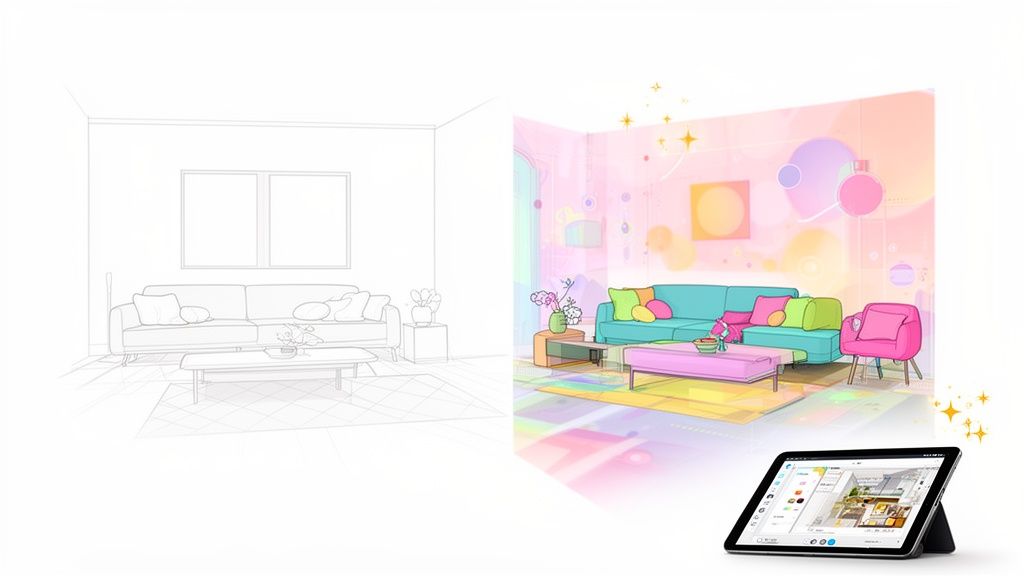
The big idea here is simple but incredibly effective: replace uncertainty with a crystal-clear picture. Instead of just imagining how that new sofa might look, you can actually see it placed in a photorealistic version of your room with an AI Home Décor platform. This digital-first approach changes the game for homeowners, real estate agents, and even professional designers.
The real magic is how this technology closes the gap between your imagination and reality. It gives you the confidence to experiment freely and helps you sidestep expensive mistakes.
This process just wipes out the biggest headaches that come with home makeovers. The fear of picking the wrong paint color or buying a couch that completely overwhelms the room? Gone.
Who Is This For?
Virtual interior design has an incredibly wide reach, with practical uses for all sorts of projects, from a quick refresh to a complete gut renovation.
Here’s a quick rundown of who’s using these tools:
Homeowners & DIYers: Finally, you can plan that weekend project or test out a wild idea without any risk. It gives you a clear visual blueprint to follow.
Real Estate Professionals: Stage empty homes virtually to help buyers see the potential. It’s a proven way to attract more interest and sell listings faster.
Interior Designers: Create client presentations in a fraction of the time, offer more design options, and communicate your vision with perfect clarity.
At the end of the day, this tech makes good design accessible to more people. Whether you're a seasoned pro or just figuring out your style, powerful creative tools are at your fingertips. For a little inspiration, check out this gallery of AI-powered transformations to see what’s possible.
This isn't just about making rooms look pretty—it's about making the entire design process smarter, faster, and a lot more fun.
How Virtual Interior Design Actually Works
Ever wished you could "try on" a new look for your room before committing to paint, furniture, and all the work? That's exactly what virtual interior design lets you do. It’s like a high-tech preview that takes the guesswork out of decorating.
Instead of just imagining how a new sofa or wall color might look, you can see it in a photorealistic image in a matter of minutes. The whole process is surprisingly simple, blending your creative ideas with some seriously smart technology.
It All Starts With a Single Photo
The journey begins with a simple picture from your phone. Just snap a photo of the room you want to redesign—the living room, kitchen, bedroom, you name it—and upload it to a design platform. This photo becomes your digital canvas.
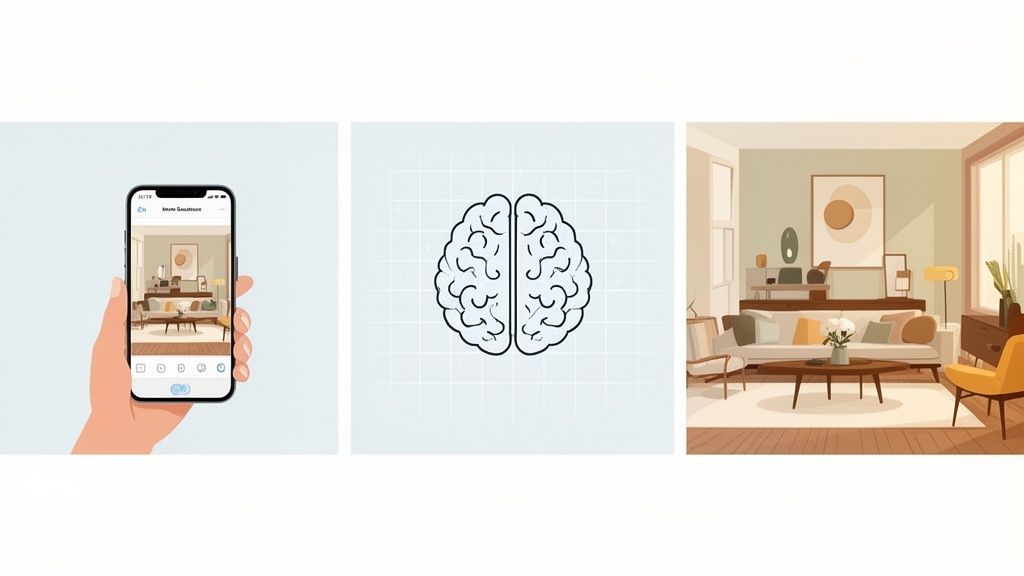
This is where the magic kicks in. The platform’s AI Room Design algorithm instantly gets to work, analyzing every part of your photo. It maps out the walls, floors, windows, and any existing furniture. It even registers the current lighting and shadows to make sure any changes it makes look completely natural and true-to-life.
You're the Creative Director
Once the AI understands your space, you’re in the driver's seat. You tell the AI what you want to see, and you can be as vague or as specific as you like. There are a few ways to give your instructions:
Pick a Style: Most tools come with a library of pre-set styles. You can just tap on 'Modern Farmhouse,' 'Industrial,' or 'Bohemian,' and the AI will instantly apply that vibe to your room.
Use Your Words: For a more custom look, you can just type what you’re thinking. Something like, "Give me a minimalist living room with a light oak floor, a plush grey sectional, and a single large abstract painting on the main wall."
Upload an Inspiration Pic: See a look you love online? Some platforms let you upload a reference photo, and the AI will mimic that style in your own space.
This direct collaboration is what makes virtual design so different. You don't need to be a tech wizard or learn complicated software; you just have to describe your vision. This accessibility is a huge reason why the AI Interior Design market is projected to explode from $3.3 billion in 2025 to over $15 billion by 2033. If you want to dive deeper, you can read the full research on AI in interior design and see what's driving this growth.
From Your Idea to a Realistic Image
After you’ve given your directions, the AI gets to work. It digitally "paints" over your photo—swapping out the floors, changing the wall color, and adding or removing furniture and decor. The technology is so sophisticated that it calculates how light would hit new objects, creating realistic shadows and reflections that make the final image feel real.
The ultimate goal is to generate a picture so convincing you’d struggle to tell it apart from an actual photograph. The AI renders everything with incredible detail, from the soft texture of a velvet couch to the subtle grain in a wooden table.
The best part? This entire process, from uploading your photo to getting back a handful of stunning design concepts, usually takes less than a minute. What you get isn’t just a rough sketch, but a clear, high-resolution image you can use as a blueprint for your project. You can learn more about how to transform your space with a room redesign and see just how easy it is to get started.
To put it all in perspective, let’s quickly compare how this modern approach stacks up against the old-school way of doing things.
Traditional Vs Virtual Interior Design At A Glance
This table breaks down the key differences between hiring a traditional designer and using a virtual design tool.
Aspect | Traditional Interior Design | Virtual Interior Design |
|---|---|---|
Process | In-person meetings, manual measurements, physical mood boards, slow revisions. | Online collaboration, photo uploads, digital mood boards, instant revisions. |
Cost | Typically $2,000 - $12,000+ per room, often billed hourly or as a flat fee. | Much more affordable, ranging from free to a few hundred dollars per room. |
Timeline | Weeks or even months from initial consultation to final design concept. | Minutes or hours to receive multiple design concepts. |
Flexibility | Limited to designer's schedule; revisions can be time-consuming and costly. | Design anytime, anywhere; explore dozens of ideas with no extra cost. |
Visualization | Relies on 2D floor plans, fabric swatches, and your imagination. | Provides photorealistic 3D renderings to see the final look upfront. |
As you can see, the virtual route offers a massive advantage in speed, cost, and the sheer number of ideas you can explore without any real-world commitment.
What's In It For Homeowners and Real Estate Pros?
Virtual interior design offers some serious, real-world advantages that go way beyond just making things look pretty. Whether you're a homeowner gearing up for a DIY project or a real estate agent trying to close a deal faster, these tools save time, cut costs, and flat-out deliver better results. It’s all about making smarter decisions, with a lot more confidence.
For homeowners, the biggest win is taking the guesswork out of design. You can test out every single idea—from a wild accent wall to a total furniture swap—before you spend a dime. That freedom to experiment without the risk is a huge relief for anyone who's ever been frozen by indecision.
Save Money and Get Creative
We’ve all been there. The fear of making a pricey mistake can totally kill your creativity. Will that gorgeous but expensive sofa actually work in your space? Is that trendy paint color going to look as good on the wall as it does on that tiny paper swatch?
Virtual interior design gives you the answers right away.
By seeing it all first, you stop yourself from buying furniture that doesn’t fit or having to repaint an entire room because the color just wasn't right. It’s like having an "undo" button for your home. This gives you the green light to try bolder ideas without the financial hangover. You can finally figure out your true style and build a space that feels like you. Learning how to visualize your home before you even start the renovation is the key to a smoother, more satisfying project.
Sell Homes Faster and For More Money
For real estate pros, the benefits hit the bottom line directly. An empty house might be a blank canvas, but to most buyers, it's just a confusing, cold space. It’s tough for people to imagine their own lives—and their own stuff—in a vacant room.
This is where AI Virtual Staging completely changes the game. By digitally adding stylish, perfectly-scaled furniture to an empty listing, agents can show off a property's true potential. It creates an instant emotional spark, helping buyers see the space not as four walls, but as their future home. A big part of the magic is how virtual staging when selling a home helps people connect with the lifestyle a property offers, which almost always leads to quicker sales and better offers.
The numbers don't lie. The move to digital design platforms exploded during the COVID-19 pandemic, pushing the virtual design market to an estimated $18.20 billion. It's now on track to hit $30.96 billion by 2029. Even more telling for real estate, agents report that virtually staged listings sell 73% faster on average.
By transforming an empty, uninviting space into a warm, fully-furnished home online, real estate professionals can attract more qualified buyers and command better prices—all for a fraction of the cost of traditional physical staging.
A Secret Weapon For Professional Designers
While it's great for homeowners, virtual design is also an absolute powerhouse for seasoned professionals. It dramatically speeds up the entire creative process, letting designers mock up multiple, high-quality concepts for clients in a fraction of the time it used to take.
Instead of spending hours on hand-drawn sketches or wrestling with complex 3D software, designers can use AI Home Décor tools to generate stunning visuals in minutes. This new efficiency means they can:
Offer More Choices: Quickly show a client several different styles or layouts, helping them land on a direction they love.
Communicate Clearly: A photorealistic image gets an idea across way better than a mood board or a long-winded explanation. Everyone sees the same vision.
Handle Revisions in a Snap: Client feedback like, "Can I see that with a different rug?" can be turned around almost instantly, making the approval process a breeze.
This tech doesn't replace a designer's expertise—it supercharges it. By taking over the tedious rendering work, it frees up professionals to focus on what they do best: the creative strategy that makes a project shine. The end result is happier clients and a better final product.
Exploring The Technology Behind Virtual Design
To really get what makes virtual interior design tick, it helps to look at the different kinds of technology making it all possible. It’s not just one single thing; it’s more like a collection of specialized tools, each designed for a particular job. These tools are what bring sophisticated design capabilities to everyone, from a homeowner planning a weekend project to a developer marketing a brand-new building.
Let's break down the main engines that are driving these transformations.
All-In-One AI Interior Design Platforms
Think of these as the Swiss Army knives of the virtual design world. They’re web and mobile apps built for one thing: simplicity. They pack powerful features into a super intuitive interface. You just upload a photo of your room, type in a prompt or pick a style from a menu, and the platform does all the heavy lifting.
Behind the scenes, these platforms use a mix of computer vision to understand the layout of your space and generative AI to dream up new visuals based on your input. The whole point is to make it feel less like you're wrestling with complicated software and more like you're having a creative chat with a designer.
Here’s a great example of a typical platform’s interface. Notice how clean and simple it is to get started.
The layout gets straight to the point: upload a photo, choose a style. It removes all the technical roadblocks and lets you focus on the fun part—the design itself.
APIs and SDKs for Business Integration
While all-in-one platforms are perfect for individuals, businesses often need to weave this technology right into their own websites or apps. That’s where Application Programming Interfaces (APIs) and Software Development Kits (SDKs) come into play.
Ever browsed a real estate site and seen a "Virtually Stage This Room" button on an empty listing? That's an AI Virtual Staging API at work. It lets the real estate website "talk" to a virtual design engine in the background, creating a seamless experience for potential buyers. For businesses that want to build this feature into their own digital products, you can learn more about integrating a room redesign API to see how it all connects.
APIs are essentially messengers that let different software programs communicate and trade information.
SDKs are ready-made toolkits that give developers the code they need to quickly add features to their own applications.
From Simple Sketch To Photorealistic Render
One of the most mind-blowing technologies in this field is sketch-to-render. It does exactly what it sounds like: it takes a rough, hand-drawn sketch or a basic 2D floor plan and turns it into a stunningly realistic 3D image. For architects and designers who need to bring a concept to life fast, this is an absolute game-changer.
This technology bridges the critical gap between a rough idea and a tangible vision. It allows professionals to bring a blueprint to life in minutes, showing clients a photorealistic preview of a space that doesn't even exist yet.
This tool is priceless for showing a project's potential long before the first nail is hammered. It gets everyone on the same page—from the client to the contractor—by providing a clear, shared visual goal.
Advanced Image Enhancement Features
Finally, there’s another layer of tech that’s all about adding that final professional polish. This is way more than just simple photo editing. It uses AI Interior Design to make smart, context-aware improvements that can completely elevate a property photo.
Some of these advanced tricks include:
Sky Replacement: Instantly swapping a dreary, overcast sky in an exterior shot with a bright, sunny one.
Day-to-Dusk Conversion: Magically turning a daytime photo into a gorgeous twilight scene, complete with warm interior lighting and a dramatic sky.
Object Removal: Digitally erasing clutter, construction debris, or any distracting items to present a clean, inviting space.
All these technologies work together to create a powerful design ecosystem. Whether you’re a DIY decorator playing with a simple app or a large real estate firm using a deeply integrated API, the goal is the same: making it faster, easier, and more accessible than ever to visualize and create beautiful spaces.
Your Step-By-Step Guide To A Virtual Redesign
Ready to see just how easy a virtual interior design project can be? Let's walk through the process together. These are the exact steps to take you from a simple photo of your room to a stunning, fully-realized design concept.
Before you even touch any technology, a little prep work goes a long way. Understanding the basics of what makes a room feel right is key. This handy step-by-step guide to designing a living room is a great place to start, as it helps you get your thoughts in order before you dive in.
Step 1: Define Your Goal And Vision
First things first, get really clear on what you’re trying to do. Are you dreaming of a sleek, modern home office that boosts productivity? Or maybe a calming coastal bedroom for total relaxation? Nailing down your goal is the single most important step—it’ll be your north star for every decision that follows.
Think about the feeling you want the room to have. Words like "cozy," "airy," "dramatic," or "serene" are fantastic starting points. When you have a clear purpose, you ensure the final design isn't just pretty but actually works for your life.
Step 2: Capture The Perfect Photo
The photo you start with is your canvas, so getting a good one is crucial for the best results. You don't need a fancy camera; your smartphone is more than enough. Just follow a few simple tips to get it right.
Let the Light In: Open the curtains and take your picture during the day. Bright, natural light helps the AI “see” the space much more clearly.
Tidy Up: A quick declutter can make a huge difference. While many tools can digitally remove items, you’ll always get a better result starting with a clean slate.
Find the Best Angle: Stand in a corner of the room to capture as much of it as possible in one shot. A wide, clear view gives the software the context it needs to work its magic.
This diagram shows just how simple the AI Home Design workflow is, from uploading your photo to getting back a beautiful, AI-powered render.
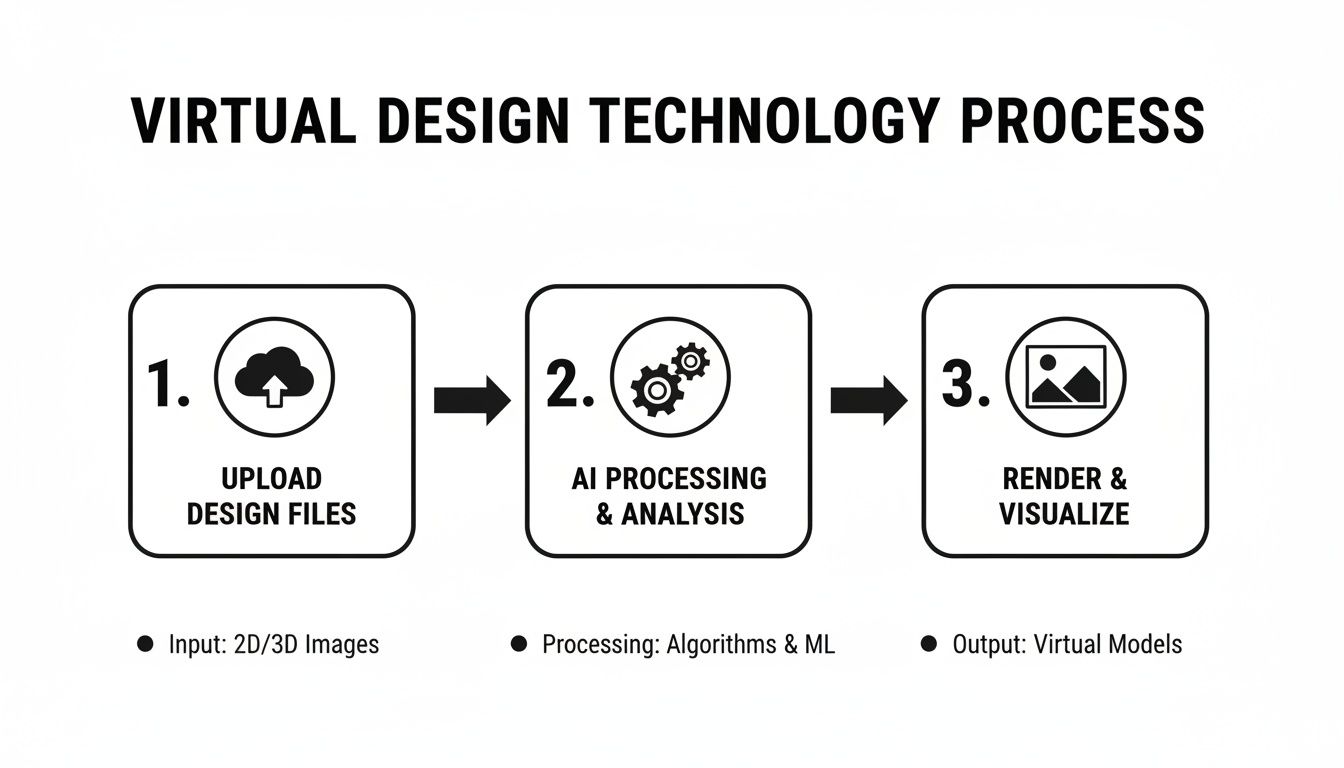
As you can see, the tech does the heavy lifting, translating your existing room into a brand-new concept in just a few moments.
Step 3: Craft An Effective Prompt
Now for the fun part—telling the AI what you have in mind. This is where your vision from Step 1 really comes to life. You can either pick a pre-set style like 'Mid-Century Modern' or get creative and write a custom text prompt.
A good prompt is specific without being too bossy. Instead of just saying “make it modern,” try painting a picture with your words: “Create a modern and cozy living room with a large grey sectional sofa, warm wood accents, and a navy blue accent wall.” The more detail you give, the closer the AI Room Design will get to your vision right off the bat. You can check out all kinds of styles and learn how to use them in our room redesign studio.
Step 4: Refine And Iterate Your Design
The first version you get is rarely the final one. The real magic of virtual design is how fast you can make changes. Don't love the rug? Want a different piece of art? Just use simple follow-up commands to tweak the results.
Think of it as a conversation with a designer. You can say things like, "Change the coffee table to a round marble one," "Make the rug larger and more colorful," or "Add more plants near the window."
This back-and-forth process lets you fine-tune every little detail until the design feels perfect. You can test out dozens of variations in minutes—something that’s completely impossible in the real world. It's this kind of risk-free experimentation that helps you feel confident in your choices and leads to a much better outcome.
Once you’re completely happy with your creation, just download the high-resolution image. This becomes your blueprint. Use it to shop for furniture, show your vision to a contractor, or even create eye-catching marketing materials for a property listing. With these simple steps, you have everything you need to start your virtual redesign today.
The Future Of Virtual Interior Design
Virtual interior design is more than just a cool new thing; it's a real change in how we think about and create the spaces we live in. It's quickly picking up speed, thanks to a perfect storm of online shopping trends, our desire for unique homes, and a bigger focus on sustainable living. This isn't just about a new process—it’s about opening up a whole new world of possibilities.
The numbers don't lie. The market for virtual interior design services is exploding, set to jump from $5.07 billion to an estimated $14.99 billion by 2035. That’s a massive leap, driven by a steady growth rate of 10.36% each year. This reflects how we're all getting more comfortable with digital tools for home projects, turning a quick photo of a room into a fully realized design in seconds. You can dig into more of this data in the virtual interior design market report from Market Research Future.
What Innovations Are On The Horizon?
The next phase of virtual design is all about making the experience feel completely natural and woven into our everyday lives. Augmented reality (AR) is going to be a huge part of this. Soon, you'll be able to hold up your phone and see a virtual sofa appear right in your living room, letting you check its size and color on the spot.
This merging of the digital and physical worlds will finally take the last bit of guesswork out of decorating.
The next generation of AI Home Design won’t just follow your instructions. It'll be more like a creative partner, suggesting styles that fit your personality, your daily routine, or even the kind of music you love.
A Smarter, More Accessible Design Process
As we look ahead, virtual interior design will keep tearing down old barriers, bringing expert-level design to anyone with an internet connection. Here are a few key developments to keep an eye on:
Hyper-Personalization: AI is getting smarter. It will start learning your specific tastes to recommend decor, furniture arrangements, and color schemes that feel like they were made just for you.
Integrated E-commerce: The journey from seeing a design you love to actually buying it will become ridiculously easy. Imagine just tapping on a lamp in your virtual design to purchase it directly from the retailer.
Sustainable Design Choices: Future tools will double as your green design consultant, pointing you toward eco-friendly materials, cool second-hand furniture finds, and layouts that save on energy.
In the end, the future is all about a powerful partnership between human creativity and smart technology. AI and virtual design will become the go-to tools that empower us all to craft spaces that aren't just beautiful, but are a true reflection of how we live.
Got Questions About Virtual Design? We've Got Answers.
Jumping into the world of virtual interior design for the first time? It's natural to have a few questions. To make sure you get started with total confidence, we’ve answered some of the most common ones we hear about this amazing technology.
How Realistic Are The Final Images?
Honestly, the results from modern AI Interior Design tools are stunningly photorealistic. They've gotten incredibly good at mimicking the small details that make a space feel real—things like the subtle play of natural light, the way shadows fall, and the specific textures of different materials.
The final image is often so convincing, you'd have a hard time telling it apart from a professional photograph. Of course, the quality of your original photo and the detail in your instructions play a role, but the best platforms out there are built to deliver listing-ready images every single time.
Do I Need Any Design Experience To Use This?
Not at all. And that’s really the whole point. One of the best things about these new virtual design platforms is that they were built for everyone, no matter your background. You don’t need any formal training to get a beautiful result.
The goal of these AI Home Décor tools is to open up the design process, making it simple and even fun. With features like pre-set style libraries and easy-to-use text commands, anyone can turn their ideas into a professional-looking room design.
The core idea here is to empower your creativity, not to test your technical skills. If you can describe what you like, you have all the experience you need to get started.
Can I Use Specific Brands For Paint Or Furniture?
Yes, and this is where it gets really powerful. Many of the more advanced platforms have this feature built right in, which turns your design from just a pretty picture into a real, actionable plan.
For example, you can often ask for exact paint colors from brands like Sherwin-Williams or Benjamin Moore to see exactly how they’ll look on your walls. The same goes for furniture—you can request specific styles, materials, or even pieces that look like they came straight from your favorite retailers. This helps ensure the design you fall in love with is one you can actually create.
Ready to stop guessing and start visualizing? With Decor8 AI, you can transform any room in your home with just a photo and an idea. Get started for free today and see your vision come to life!
Comments