
Your Ultimate Basement Kitchen Design Guide
Adding a kitchen to your basement can completely change the way you use your home. It’s a project that turns a forgotten-about space into a serious asset—whether that's a new rental apartment, a cozy in-law suite, or the ultimate entertainment hub.
Starting Your Basement Kitchen Journey
Before you even think about picking out countertops or cabinet colors, the real work begins with a hard look at the space you have. This is where a successful project is born. You have to be honest about the limitations of a basement—things like low ceilings, moisture, and where your utilities are (or aren't).
Skipping this foundational planning is the quickest way to blow your budget and end up with major headaches. Let's walk through how to start smart.
Kitchen vs. Kitchenette: What Do You Really Need?
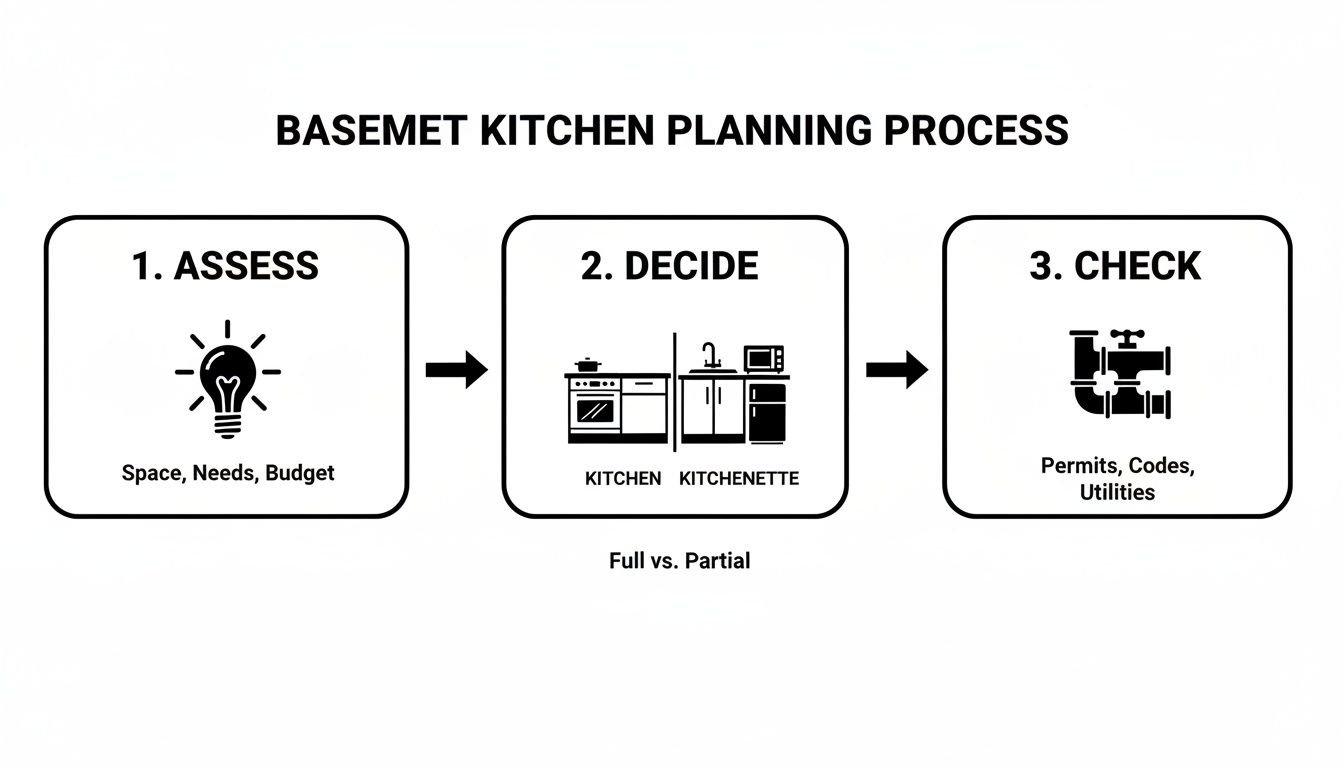
First things first: what kind of "kitchen" are we talking about? The scope of your project hinges on this one question, because a full kitchen and a simple kitchenette are two very different beasts.
Full Kitchen: This is your go-to for a legal rental unit or a completely independent living space. Think a full-size fridge, a proper range with an oven, a dishwasher, and plenty of counter space for actual meal prep. This route is more involved, requiring beefier electrical work, more complex plumbing, and serious ventilation.
Kitchenette: If you're building a wet bar for a game room or a small prep area for guests, a kitchenette is perfect. We're talking a mini-fridge, maybe a microwave, and a small sink. It’s a much simpler, more affordable option with fewer demands on your home’s existing systems.
Deciding this upfront sets the stage for everything else. An entertainment bar doesn't need a 240-volt outlet for a stove, and you can't realistically rent out a suite that only has a microwave.
Expert Insight: A well-designed basement kitchen is a solid investment. While the average basement remodel recoups about 50-70% of its cost at resale, adding a functional kitchen can push that number higher, especially if you're creating a rentable or multi-generational living space.
This simple flowchart breaks down the initial thought process perfectly. It's all about assessing the space, deciding on the scope, and checking your home's core systems before you swing a single hammer.
The Foundational Reality Check
Once you know what you're building, it's time to get real about the existing conditions. This is where you might need to call in a pro—a plumber or an electrician—to get a clear picture.
Start by mapping out your utilities. Where are the main plumbing drain lines? How far away is the nearest hot and cold water supply? Tying into existing pipes is always cheaper than jackhammering concrete to run new ones across the basement. The same goes for your electrical panel and HVAC ductwork.
Here’s a quick overview to keep your planning on track.
| Basement Kitchen Project At-a-Glance Checklist || :--- | :--- | :--- || Planning Stage | Key Considerations | Why It Matters || Purpose & Scope | Full kitchen or kitchenette? Rental unit, in-law suite, or entertainment space? | Determines budget, complexity, and necessary permits. || Utilities Assessment | Location of existing plumbing drains, water lines, and electrical panel. | Tapping into nearby utilities saves thousands in labor and materials. || Moisture & Ventilation | Any signs of dampness? How will you vent cooking fumes and moisture? | Prevents mold, protects your investment, and is often a code requirement. || Egress & Code | Do you have a proper emergency exit? What are local code requirements? | Ensures the space is safe, legal, and habitable. |
If you're also thinking about adding a bathroom down there, planning the plumbing for both at the same time is a huge money-saver. You can learn more about how those systems work together in our complete guide to a basement bathroom remodel.
Moisture is the natural enemy of any basement project. Before you do anything else, make sure your foundation is dry and properly waterproofed. You'll also need a solid plan for ventilation to deal with cooking steam and smells—this isn't just a nice-to-have, it's often mandated by building codes.
Getting these fundamentals right is the key to a successful build. For a great overview that applies just as well to basements, check out this guide on how to plan a kitchen remodel. A little due diligence now ensures your new kitchen is built on a foundation that will last.
Getting Real with Building Codes and Utilities
This is where the dream of your perfect basement kitchen bumps up against reality. Before you fall in love with a specific cabinet finish or countertop, you have to tackle the unglamorous but absolutely critical world of building codes, plumbing, and electrical work.
Trust me, skipping this step is a recipe for disaster. I've seen it happen. Overlooking these details can lead to failed inspections, expensive do-overs, and a space that’s just not safe.
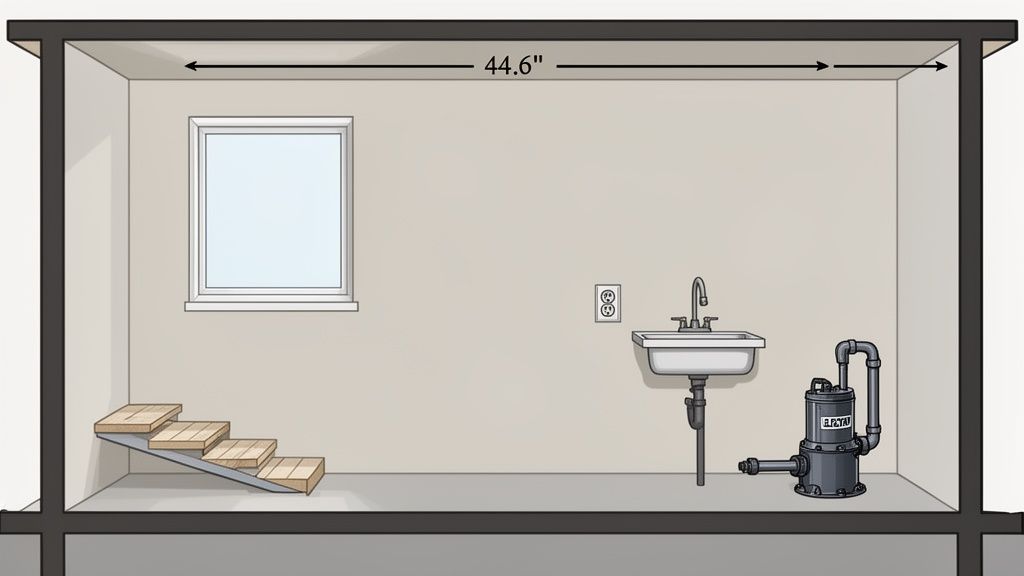
Think of codes as the official rulebook for a safe home. They aren't suggestions; they're laws put in place to protect you and your investment. Getting this part right from the start means your project will go smoother, your family will be safe, and you'll actually add value to your property.
Key Code Requirements You Can't Ignore
Codes change from town to town, so you’ll absolutely need to check with your local building department. That said, a few big-ticket items are almost always on the list for a basement project like this.
Egress Windows and DoorsIf your basement is going to be a living space (and a kitchen definitely qualifies), you’ll almost certainly need a proper egress exit. This is a non-negotiable safety feature for escaping during a fire.
Minimum Opening Size: The standard is usually a clear opening of at least 5.7 square feet.
Window Well: If your egress window is below ground, it needs a window well with a built-in, permanent ladder.
Clear Dimensions: The opening itself has to be at least 24 inches high and 20 inches wide.
Ceiling HeightWe all know basements often have low ceilings. The problem is, building codes have a say in how low is too low. For a habitable room, you’re typically looking at a required finished ceiling height of 7 feet. Beams and ductwork can sometimes hang a bit lower, but the main area has to meet that height.
A Pro Tip from the Field: Before you even think about framing, grab a tape measure. Check the distance from the concrete floor to the lowest point of your overhead joists or pipes. That number is your absolute maximum ceiling height once you add flooring and drywall. It’s the number you have to work with.
The Below-Grade Plumbing Puzzle
Here's a fun fact about basements: they're below your home's main drain line. Gravity isn't on your side down here. You can't just connect a sink and expect the water to drain away.
To solve this, you'll need a little help. The most common fix is an ejector pump (sometimes called a lift station). It's a pretty slick system: a basin collects all the wastewater from your sink and dishwasher, and when it gets full, a pump kicks on and sends it up and out to the main sewer line.
Another route is an upflush system, which some people use for basement bathrooms. Certain models have extra ports that can handle a kitchen sink. They can be less invasive because you don't have to break up your concrete floor. A good plumber will be able to look at your space and tell you which solution makes the most sense.
Don't Skimp on Electrical and Ventilation
A safe and comfortable basement kitchen relies heavily on proper wiring and good airflow. Cutting corners here is a massive risk—you're talking about potential fire hazards and a breeding ground for mold.
GFCI Protection is a MustGround Fault Circuit Interrupter (GFCI) outlets are your best friend near water. They detect tiny changes in electrical current and shut the power off in an instant to prevent a nasty shock.
Code requires them for any countertop outlet within 6 feet of the sink.
Your dishwasher and any outlets in unfinished parts of the basement will need them, too.
Give Appliances Their Own CircuitsYour big appliances are power-hungry. They each need their own dedicated circuit so they don't overload your system and trip the breaker all the time. Plan for separate circuits for:
Refrigerator
Range/Cooktop
Microwave
Dishwasher
Mechanical VentilationCooking creates a ton of moisture, grease, and odors. In an enclosed basement, that's a recipe for musty smells and mold growth. Because of this, most codes now require a range hood that vents directly outside. Those recirculating hoods with a simple filter just won't cut it. For more on this, you can learn about the latest intelligent ventilation systems for optimal air quality that can keep your new space feeling fresh and dry for the long haul.
Designing a Bright and Functional Layout
Once you've handled the technical groundwork, it's time for the fun part: thinking about how you'll actually live and work in your new kitchen. A truly successful basement kitchen doesn't feel like a compromise. It feels bright, intuitive, and so well-designed that you completely forget you're below ground.
This isn't about following a strict template. It’s about being clever and adapting timeless design principles to a space that has its own unique quirks, whether that’s a support column right in the middle of the room or some low-hanging ductwork.
Smart Layouts for Challenging Spaces
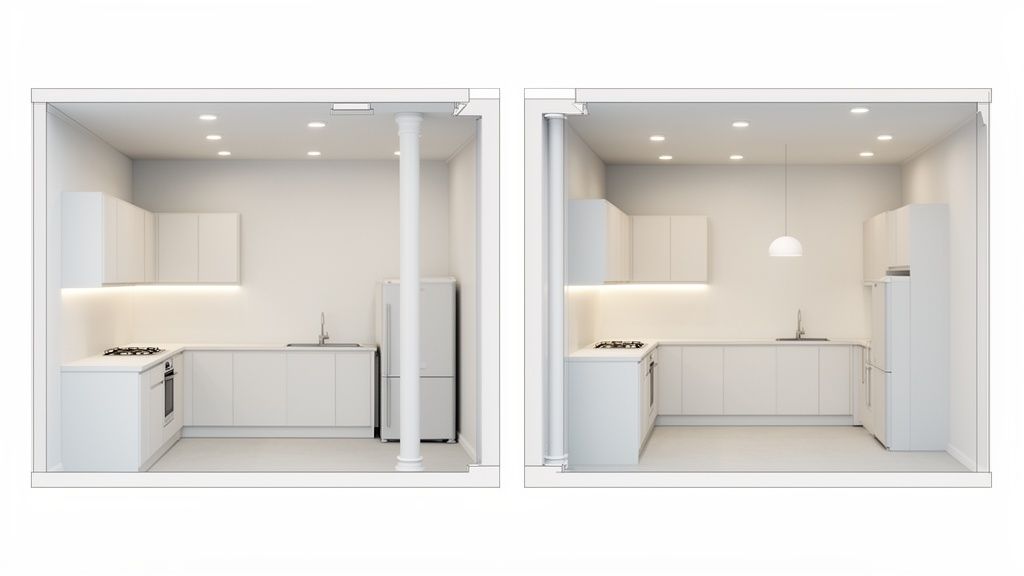
Let’s be honest, basements rarely give you a perfect blank slate. You're usually working around support posts, staircases, or utility closets. Instead of fighting them, use these features as anchors for your layout. For most basements, a single-wall or galley kitchen makes the most sense.
Single-Wall Kitchens: This is the ultimate space-saver. It lines up all your cabinets, appliances, and countertops along a single wall, which is perfect for long, narrow spaces or areas that have to pull double-duty as a living room. The trick is to create a logical flow: fridge on one end, sink in the middle, and stove on the other.
Galley Kitchens: With two parallel runs of cabinets and a walkway in between, a galley layout is incredibly efficient. It's also a fantastic solution for dealing with an awkwardly placed support column—you can just build the column right into one of the cabinet runs or a small island.
No matter which layout you lean towards, the classic work triangle is still your best friend. This concept keeps your main work zones—the fridge, sink, and stove—within easy reach of each other. Even in a tight basement, a thoughtful placement of these three elements will make cooking feel a whole lot smoother.
The Power of Layered Lighting
If there’s one thing that will make or break your basement kitchen, it's the lighting. Get it wrong, and even the most expensive kitchen will feel like a dungeon. The secret isn't one big, bright light; it's using several layers of light that work together.
A single ceiling fixture just won't do the job. You need a strategic mix:
Ambient Lighting: This is your room's main light source. In a basement, your best bet is recessed can lights. I recommend the slim LED models because they need very little ceiling clearance and cast a clean, even glow.
Task Lighting: This is all about putting focused light exactly where you need it. Under-cabinet lighting is non-negotiable. LED strips will light up your countertops, making chopping and prep work much safer and more pleasant.
Accent Lighting: Think of this as the jewelry for your kitchen. A cool pendant light over a peninsula or a couple of wall sconces can add a ton of personality and create a warm, inviting focal point.
Key Takeaway: Pay attention to color temperature, which is measured in Kelvins (K). For a kitchen, you'll want bulbs in the 3000K to 4000K range. This gives you a bright, neutral light that’s perfect for seeing what you’re doing without feeling cold and clinical.
For more great ideas on making a space feel bright and airy, check out our guide on Scandinavian kitchen design. The principles translate perfectly to basements, where light is everything.
Proactive Moisture and Air Quality Control
Finally, we need to talk about the silent killer of any basement project: moisture. Even in a fully waterproofed basement, the simple act of cooking introduces a lot of steam and humidity. If you don't manage it, you're setting yourself up for musty smells and potential mold.
A range hood that vents directly outside is your first and most important line of defense. A recirculating hood just won’t cut it down here. On top of that, I always recommend these two additions:
Waterproof Flooring: Go with something that moisture can't hurt. Luxury vinyl plank (LVP), porcelain tile, and even sealed concrete are all fantastic, durable choices.
Dedicated Dehumidifier: This is a smart investment. Tying a whole-basement dehumidifier into your HVAC system will automatically keep humidity in check, protecting your new cabinets and ensuring the air always feels fresh.
By planning for an efficient layout, layered lighting, and solid moisture control from day one, you'll create a basement kitchen that’s not just functional, but a genuinely beautiful and inviting space for everyone to enjoy.
Choosing Resilient Materials and Smart Appliances
This is where the rubber meets the road. Your choices in materials and appliances are what make a basement kitchen truly last. A below-grade space has its own set of rules, demanding finishes that can shrug off moisture and appliances that are clever with every inch. Getting this right isn't just about looks—it's about building a kitchen that won't give you headaches down the line.
Let's be real, this is also where a good chunk of your budget will live. It’s an investment homeowners are willing to make, too. In 2023, around 45% of homeowners jumped into a kitchen remodel, with many spending between $25,000 and $50,000 for a complete overhaul. That tells you just how much value people place on getting this space right.
Flooring and Countertops Built for Basements
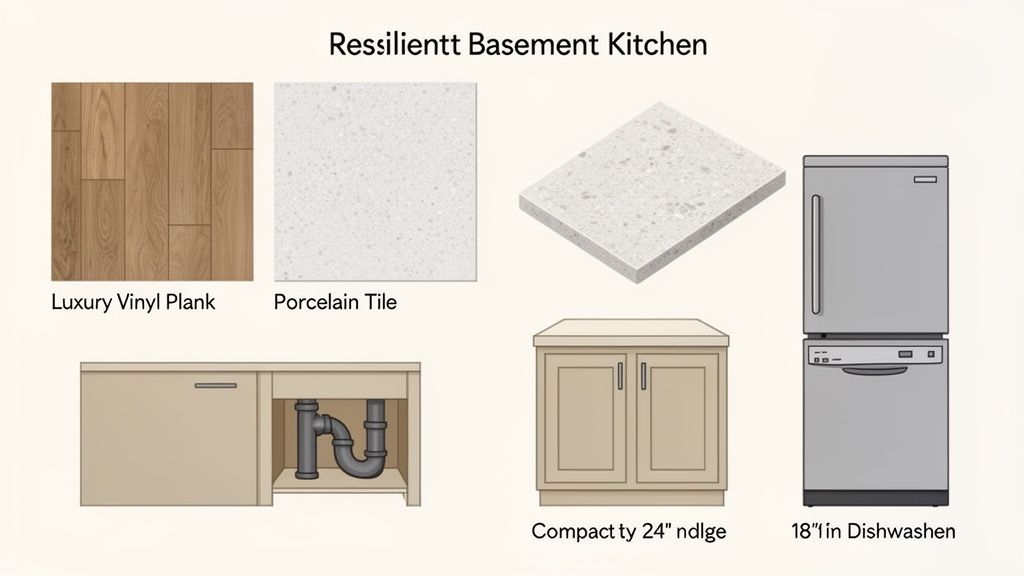
When you're picking finishes, your mantra should be "waterproof and low-maintenance," starting from the ground up. The floor is your primary defense against moisture, whether it's seeping up through the concrete slab or from an unexpected leak.
Luxury Vinyl Plank (LVP): This stuff is a superstar in basements for a reason. It's 100% waterproof, tough as nails, and looks shockingly like real wood or stone. Plus, it’s a lot warmer and more forgiving underfoot than cold, hard tile.
Porcelain or Ceramic Tile: You can't go wrong with tile. It's another completely waterproof, ultra-durable choice. A pro tip: using larger tiles minimizes grout lines, which not only means less scrubbing but also makes a small basement kitchen feel more open and expansive.
To make an informed decision, it's worth digging into the best waterproof flooring for basements to see what fits your style and budget.
For countertops, you want to avoid anything porous. Materials like marble or butcher block look beautiful upstairs, but in a basement, they can be a magnet for stains and moisture.
Expert Recommendation: I almost always steer clients toward quartz countertops for basement kitchens. Because it's a non-porous, engineered material, it naturally resists staining, mold, and mildew without ever needing to be sealed. You get that high-end stone look with none of the high-maintenance worries.
Smart Cabinetry and Appliance Selection
Choosing cabinets for a basement means finding the sweet spot between cost, durability, and the quirks of the space, like working around ductwork or support columns.
While solid wood is a classic, it can expand and contract with humidity changes. Materials like thermofoil or a high-quality MDF (medium-density fiberboard) are often more dimensionally stable, making them a safer bet for a below-grade environment. Semi-custom cabinets can be a lifesaver here, letting you order specific depths to hide a plumbing stack or beautifully wrap a support post into your island design. Believe it or not, the future might make this even easier with emerging ideas like self-cleaning kitchen surfaces through nano AI tech.
Appliances That Maximize Your Space
In a basement kitchen, space is a premium. Going with compact, multi-functional appliances is one of the smartest moves you can make to free up precious counter and storage real estate.
Appliance Type | Standard Size | Compact Alternative | Why It Works in a Basement |
|---|---|---|---|
Refrigerator | 36 inches wide | 24 inches wide | Frees up critical floor space and is usually plenty of storage for a secondary kitchen. |
Dishwasher | 24 inches wide | 18 inches wide | Perfect for an in-law suite or bar; you gain an extra 6 inches of valuable cabinet space. |
Range/Oven | 30 inches wide | 24-inch range or cooktop | A smaller range or a simple two-burner induction cooktop can drastically open up your counter area. |
Microwave | Countertop model | Over-the-range or convection | An over-the-range model kills two birds with one stone (cooking and ventilation). A convection microwave can even double as a small oven. |
Don't think that smaller means weaker. Many top-tier brands now offer powerful, efficient appliances in these compact sizes, designed for urban apartments, ADUs, and—you guessed it—basement kitchens. Making these strategic choices ensures your new kitchen isn't just tough, but incredibly functional, too.
See It Come to Life with Decor8 AI Before You Build
So, you've got a layout and a shortlist of materials. Now comes the hard part: trying to picture how it will all look. Will those dark, moody cabinets make the space feel like a cave? Does that bold backsplash tile actually clash with the flooring you fell in love with?
This is the point where doubt creeps in. It used to be a game of guesswork, expensive sample tiles, and hoping for the best. Not anymore.
With a tool like Decor8 AI, you can bridge the gap between abstract ideas and a picture-perfect reality. It’s about seeing your finished basement kitchen before you spend a dime on labor or materials. This is how you build with total confidence.
Instantly "Test Drive" Your Design Ideas
The process is surprisingly simple. Just snap a photo of your unfinished, cluttered, or even newly framed-out basement. From there, you can start generating dozens of different design concepts to see what’s truly possible in your unique space.
Think about it. You can virtually “paint” your cabinets with actual colors from brands like Sherwin-Williams or Benjamin Moore. You can swap out countertops from quartz to butcher block, try on different backsplash patterns, and see how LVP flooring looks next to your final cabinetry choice. This kind of immediate visual feedback is invaluable for making smart, decisive choices.
Go Beyond the Kitchen with Virtual Staging
A basement kitchen is rarely just a kitchen; it’s usually the heart of a larger living or entertainment area. Making sure the entire lower level feels connected and intentional is what separates a good renovation from a great one.
Decor8 AI's virtual staging feature lets you furnish the rest of the room. You can place sofas, choose area rugs, and add lighting to ensure the whole open-concept space flows beautifully.
By creating different versions, you can A/B test your most important decisions. See for yourself how light cabinets open up the room versus how dark cabinets create a cozy, dramatic vibe.
This isn't just about aesthetics; it's about avoiding expensive mistakes. For instance, recent trends show a huge shift away from the classic all-white kitchen. According to the latest home remodeling statistics, designers and homeowners are leaning into warmer, character-rich spaces. Think medium-to-dark wood cabinets like walnut and mahogany, paired with earthy, natural materials. With AI, you can test these exact trends in your own home before committing.
Pro Tip: Handing your contractor a photorealistic rendering of your final design is the ultimate communication tool. It creates a crystal-clear visual blueprint, minimizing misunderstandings and ensuring the finished product is exactly what you envisioned.
Fine-Tuning the Details
Once you've landed on a general style you love, you can really zoom in on the specifics. The ability to test specific cabinet finishes is a game-changer. You can see precisely how different shades and styles will react to your planned lighting. For a closer look at this process, check out our guide on how to visualize kitchen cabinet colors with Decor8 AI.
Ultimately, this technology transforms the design phase from a source of stress into an exciting, creative process. It empowers you to make bold choices and build with absolute certainty.
Got Questions About Your Basement Kitchen? We've Got Answers.
When you're planning a basement kitchen, a lot of questions pop up. It’s a unique project with its own set of challenges, and it's easy to get bogged down in the details. Let's tackle some of the most common hurdles right now so you can move forward with confidence.
Knowing the answers to these questions will help you have smarter conversations with your contractor and make decisions that you won’t regret later. Think of it as turning potential headaches into a well-managed part of your plan.
Do I Really Need a Permit for a Basement Kitchen?
In short: Yes, you almost certainly do. Adding a kitchen isn't like painting a room; it’s a major renovation involving new plumbing, high-power electrical circuits, and ventilation. Your local building department needs to make sure all that work is done safely and up to code.
Don't think of a permit as red tape. It’s your safety net. It ensures the work is properly inspected, which is essential for your homeowner's insurance and your home's resale value. Skipping this step can lead to massive fines or, even worse, being forced to rip out all your hard work. Before you do anything else, call your local building department and ask what they require.
What's the Biggest Mistake People Make?
The single biggest design flaw I see in basement kitchens is poor lighting. It sounds simple, but it’s everything. Basements are inherently dark, and if you don't aggressively compensate for the lack of natural light, the most beautiful kitchen will still feel like a dungeon.
A successful basement kitchen absolutely depends on a layered lighting plan. You need a combination of bright overhead ambient light (like recessed LEDs), sharp task lighting under the cabinets for your prep space, and maybe even a few accent lights to give the room some character. Don't let bad lighting sink your entire investment.
How Do I Make My Low Ceiling Feel Taller?
Low ceilings are the classic basement problem, but you can definitely trick the eye into seeing more height. The whole game is about drawing the eye upward and making the space feel as open as possible.
Here are a few tricks that actually work:
Go Vertical: Think about a backsplash with vertically stacked subway tiles or cabinet pulls that are long and slim. These simple lines create a subtle illusion of height.
Lighten Up: Choose lighter paint colors for your walls and cabinets. A bright, flat white on the ceiling is non-negotiable. When the walls and ceiling are similar in color, it blurs the boundary and makes the whole room feel more expansive.
Use Low-Profile Lights: Slim recessed LEDs are a must. They give you powerful, clean light without dropping down and visually shrinking the space the way a pendant light would.
Is a Gas Stove an Option Down There?
A gas stove is almost never a good idea for a basement kitchen, and in many places, it’s not even allowed. It all comes down to ventilation. Gas appliances create combustion byproducts, including dangerous carbon monoxide, that have to be vented directly outside.
Trying to run that kind of ductwork from a below-grade room is a huge, expensive challenge and often violates building codes because of the safety risks. This is why an electric or induction cooktop is the go-to choice. They are incredibly efficient, far easier to install in a basement, and completely remove the safety concerns that come with piping gas into an enclosed, underground space.
Ready to stop guessing and start seeing? With Decor8 AI, you can upload a photo of your basement and watch your design ideas come to life. Experiment with cabinet styles, test out countertop materials, and find the perfect color palette before you commit. Try Decor8 AI for free and design with confidence.
Comments